You’ve read three different sourdough recipes. One says let the dough double. One says 30% rise. Another says 75%. They can’t all be right — can they?
They can. And understanding why is the single biggest unlock in sourdough baking. The correct percentage rise during bulk fermentation is not a fixed number. It is tied directly to your dough temperature — and once you understand that relationship, inconsistent results become a thing of the past.
This guide pairs directly with the Sourdough Archive Bulk Fermentation Chart, which gives you the exact target for your kitchen temperature today.
🧮 Calculate Your Bulk Fermentation Time
Calculate your expected bulk fermentation time alongside rise percentage targets:
Accounts for temperature, starter %, hydration, and flour type
=
Why “Let It Double” Is Almost Always Wrong
Doubling during bulk is the most common advice in beginner sourdough recipes — and one of the most common causes of overproofed bread.
Here is why: bulk fermentation does not end when you shape the dough. The dough keeps fermenting during pre-shape, bench rest, final shaping, and the first hour or two in the fridge during cold proof. If you let it fully double during bulk, it has already been fermenting too long by the time it hits the oven.
The result is overproofed bread — dense, gummy, flat, with poor oven spring and a tight crumb.
The Temperature-Rise Relationship
The reason different recipes call for different percentage rises is because they are written for different dough temperatures. Warm dough ferments faster and needs to be stopped earlier. Cool dough ferments slower and can go longer before overproofing.
Here is the core chart:
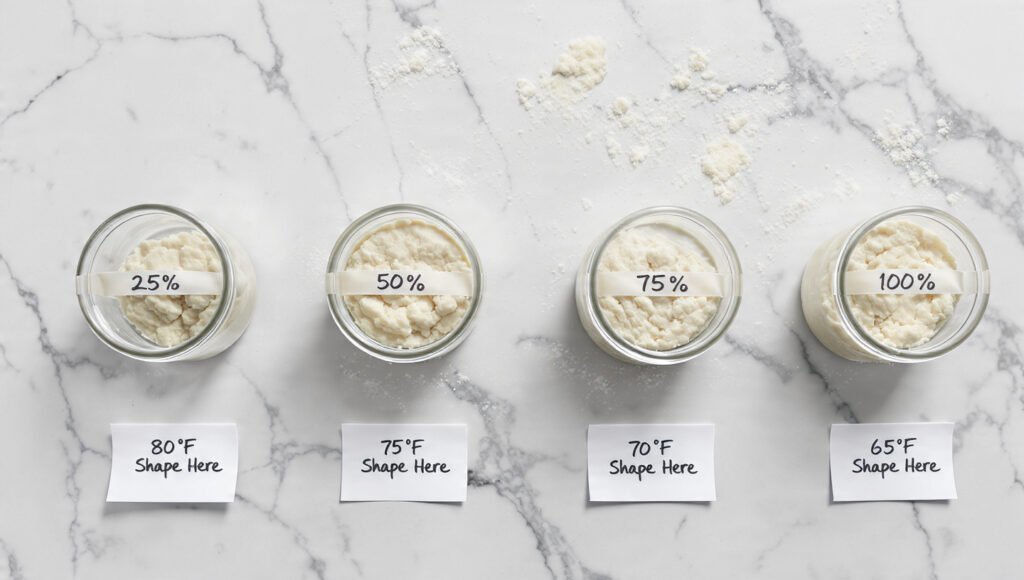
| Dough Temperature | Target Rise % | Why |
|---|---|---|
| 80°F / 27°C | 25–35% | Warm dough keeps fermenting fast in downstream steps — cut off early |
| 75°F / 24°C | 45–55% | Moderate temp, moderate target — the most common home baker scenario |
| 70°F / 21°C | 65–75% | Cooler dough ferments slower, needs more time before structure is set |
| 65°F / 18°C | 75–100% | Cold kitchens slow fermentation — dough can go further without overproofing |
This is why Tartine’s recipe calls for 30% rise (it ferments at 80°F) while many beginner recipes call for near-doubling (they assume cooler home kitchens at 68–70°F). Both are correct for their temperature. Neither is universally correct.
How to Actually Measure Percentage Rise
This is where most bakers go wrong even after they understand the concept. You cannot accurately measure percentage rise by eyeballing a bowl. You need a straight-sided container with volume markings.
Step by step:
- Transfer your mixed dough to a clear, straight-sided container with milliliter markings.
- Level the dough surface and note the starting volume in mL. Mark the level with a rubber band.
- Calculate your target volume: starting mL × (1 + target rise %).
- Example: 1,000mL dough at 75°F targeting 50% rise = stop at 1,500mL.
- Watch the container, not the clock. Shape when the dough hits your target volume.
Once you know your starting volume for a given recipe, it never changes. Write it in a baking log so you never have to measure it again.
Why Volume Rise Can Be Misleading
Percentage rise is the best single indicator of bulk fermentation progress — but it is not infallible. Two situations where it can mislead you:
High whole wheat or rye flour: Whole grain doughs have weaker gluten networks and trap gas less efficiently. A 100% whole wheat dough may only show 20–30% rise at the end of a fully fermented bulk. If you wait for 75% rise, you will overferment it. Reduce your target rise by 20–30% for high whole-grain doughs.
High hydration doughs: Very wet doughs spread outward more than they rise upward. In a wide bowl, this makes the rise look smaller than it is. This is another reason straight-sided containers matter — they prevent the dough from spreading and give you an accurate read.
In both cases, combine your percentage rise target with the 7 visual signs bulk fermentation is done — jiggle, dome, bubbles, and surface feel — for the most accurate call.
What Happens If You Go Over or Under
Underfermented (stopped too early): Dense crumb, poor oven spring, gummy texture, flat loaf. The dough didn’t have enough gas or gluten development to support a proper rise in the oven. See our guide on why sourdough comes out dense.
Overfermented (ran too long): Weak, slack dough that spreads during shaping, collapses in the oven, and produces a gummy or dense crumb despite the long fermentation. The gluten network has been broken down by excess acid. See our guide on how to fix overproofed sourdough.
The sweet spot is narrower than most beginners expect — and it gets narrower at warmer temperatures. This is why warm kitchens are harder to bake in: the margin for error on percentage rise is smaller.
Cold Bulk: A Different Target
If you are moving your dough to the fridge partway through bulk fermentation, your warm-bulk percentage rise target drops significantly. Because fermentation continues slowly in the fridge overnight, you need to stop the warm phase earlier to avoid overproofing by morning.
Typical warm-bulk target before refrigerating: 20–35%, regardless of dough temperature. The fridge handles the rest over 8–12 hours. Full guide: Cold Bulk Fermentation Explained.
Quick Reference: Find Your Target
- Dough temp 80°F+ → target 25–35% rise, shape early, move fast
- Dough temp 75°F → target 45–55% rise, the standard home baker window
- Dough temp 70°F → target 65–75% rise, watch for the dome and jiggle
- Dough temp 65°F → target 75–100% rise, patience required, trust the signs
- Cold bulk (any temp) → warm-bulk target 20–35%, fridge finishes overnight
- High whole grain → reduce any target above by 20–30%
The Bottom Line
Percentage rise is the most reliable measurable indicator of bulk fermentation — but only when paired with your dough temperature. The two numbers work together. Neither alone tells the whole story.
Measure your dough temperature right after mixing. Use a straight-sided container to track volume. Hit your temperature-matched target. Confirm with the visual signs. Shape.
That process — repeated consistently — is what separates bakers who get reliable results from bakers who wonder why every loaf is different. Use the Bulk Fermentation Chart to find your exact target for today’s bake.
2 Responses
Is temperature taken right after mixing or after the series of stretch and folds before bulk fermentation?
This is the moment you establish your Desired Dough Temperature (DDT). By taking the temperature immediately after mixing, you can tell if your water was too hot or too cold.
If the dough is too cold: You can move the bowl to a warmer spot (like an oven with the light on) for the duration of the stretch and folds to bring it up to speed.
If the dough is too hot: You can keep it in a cooler area to prevent it from fermenting too quickly.
2. The “Stretch and Fold” Nuance
Technically, bulk fermentation begins the moment the starter is mixed into the flour and water. Therefore, the stretch-and-fold period is actually the first phase of bulk fermentation.
However, your dough temperature will naturally drift toward the room temperature during the 1.5–2 hours you are performing folds.
If your kitchen is very different from your dough temp: It is a good idea to take the temperature one more time after your final stretch and fold (before you leave the dough alone to finish rising).
Which one dictates the “Target Rise %”? The temperature of the dough during the majority of the rise is what matters most. If you mixed at 80°F but your kitchen is 70°F, by the time you finish your folds, the dough might be 74°F. In that case, you should look at the 75°F / 50% rise target rather than the 80°F / 30% rise target.
The Bottom Line:
Take it after mixing to see if you hit your target.
Take it after your last fold to confirm the “engine speed” of the dough before you let it sit undisturbed to reach its percentage rise. Hope that helps