You got distracted. The meeting ran long. You fell asleep. Now you’re staring at a dough that’s been sitting for way longer than the recipe said — and wondering if it’s ruined.
Here’s the honest answer: it depends on how far over you’ve gone. Slightly over-fermented dough can often still be baked into a perfectly decent loaf. Severely over-fermented dough may only be salvageable as focaccia. And somewhere in between, there’s a range where you need to move fast and make a call.
This guide explains exactly what happens to your dough when bulk fermentation goes too long, how to diagnose how bad the damage is, and what your options are.
🧮 Calculate Your Bulk Fermentation Time
Determine if your bulk fermentation has actually gone too long by calculating the expected time:
Accounts for temperature, starter %, hydration, and flour type
What Actually Happens When Bulk Fermentation Goes Too Long
During bulk fermentation, wild yeast and bacteria consume the sugars in your flour and produce carbon dioxide (which raises the dough) and organic acids (which build flavor). This process has a window — and when that window closes, a few things start to go wrong at once.
The gluten breaks down
Wild yeast and bacteria produce enzymes called proteases as they ferment. These enzymes gradually break down the proteins in your flour — the same proteins that form gluten. Gluten is what gives your dough structure, elasticity, and the ability to hold gas and rise in the oven. When protease activity goes unchecked because bulk fermentation runs too long, the gluten network weakens and eventually collapses. The dough loses its ability to hold shape.
The food supply runs out
Once the yeast and bacteria have consumed most of the available sugars in the flour, fermentation slows dramatically. At this point, even if you bake the dough, there isn’t enough remaining yeast activity to produce meaningful oven spring. The loaf will be flat and dense.
The crust won’t brown properly
Sugars in the dough are what produce the golden-brown Maillard reaction during baking. Over-fermented dough has depleted most of those sugars — the result is a pale, dull crust that may develop burnt spots but never achieves an even, deep brown.
The flavor turns harsh
A well-fermented sourdough has a pleasant tang. Over-fermented dough tips into an unpleasant sharp sourness — sometimes described as an acrid or vinegar-forward bite — along with an alcoholic smell and occasionally an odd corn-like flavor in the crust.
How to Tell How Over-Fermented Your Dough Is
The degree of over-fermentation determines what you can still do. Use this table to assess where you stand before deciding on a course of action.
| What You See / Feel | Severity | What to Do |
|---|---|---|
| Dough is very puffy, jiggles a lot, smells strongly acidic but still holds shape when scraped out | Mildly over-fermented | Shape immediately and bake — reduce final proof time |
| Dough is very slack and sticky, spreads quickly when scraped out, hard to shape but can be folded | Moderately over-fermented | Shape and bake in a loaf pan for structural support |
| Dough is soupy, tears easily, holds no structure at all, smells strongly alcoholic | Severely over-fermented | Focaccia — spread on oiled sheet pan and bake |
| Dough is grey-tinged, slimy, or smells truly rotten (not just sour) | Spoiled | Discard — do not bake |
The Visual Signs of Over-Fermented Dough
Before you even touch the dough, you can often tell from looking at it:
- The dough has more than doubled — for sourdough, a full double or beyond during bulk is almost always too far
- The surface has flattened or sunken — a domed top that collapses or goes flat signals the dough has peaked and passed
- Large, uneven bubbles on the surface — healthy bulk fermentation shows small, even bubbles; over-fermentation produces coarser, irregular bubbling
- A crepe-like or shiny surface texture — over-fermented dough loses its matte, structured look and becomes glossy and fragile-looking
- Strong sour or alcoholic smell — more than the pleasant tang of normal fermentation
How to Save Over-Fermented Bulk Fermentation Dough
Option 1: Shape and bake immediately (mild over-fermentation)
If the dough is puffy and jiggly but still holds some structure, shape it as gently as possible — minimal handling to avoid degassing it further. Skip or dramatically shorten the final proof. Score very shallow (the dough is fragile and deep scores will cause it to collapse). Bake immediately at your normal temperature.
Expect: Less oven spring than usual, a slightly denser crumb, and a less dramatic ear on the score. But it can still be a very edible loaf.
Option 2: Bake in a loaf pan (moderate over-fermentation)
If the dough is too slack to hold a freestanding shape but can still be folded, pour or fold it into a well-greased loaf pan. The pan provides structural support that the dough itself can’t. Skip the final proof entirely and bake immediately. Score very lightly or not at all.
Expect: A denser crumb, a flatter top, and an assertive sour flavor. Still very much worth eating — especially toasted.
Option 3: Bake as focaccia (severe over-fermentation)
If the dough holds no real shape but is still intact (not truly liquified), spread it onto an oiled baking sheet or into an oiled 9×13 pan. Dimple it generously with your fingers, drizzle with good olive oil, top with flaky salt and herbs, and bake at 425–450°F until golden. Focaccia is structurally forgiving precisely because it’s meant to be flat.
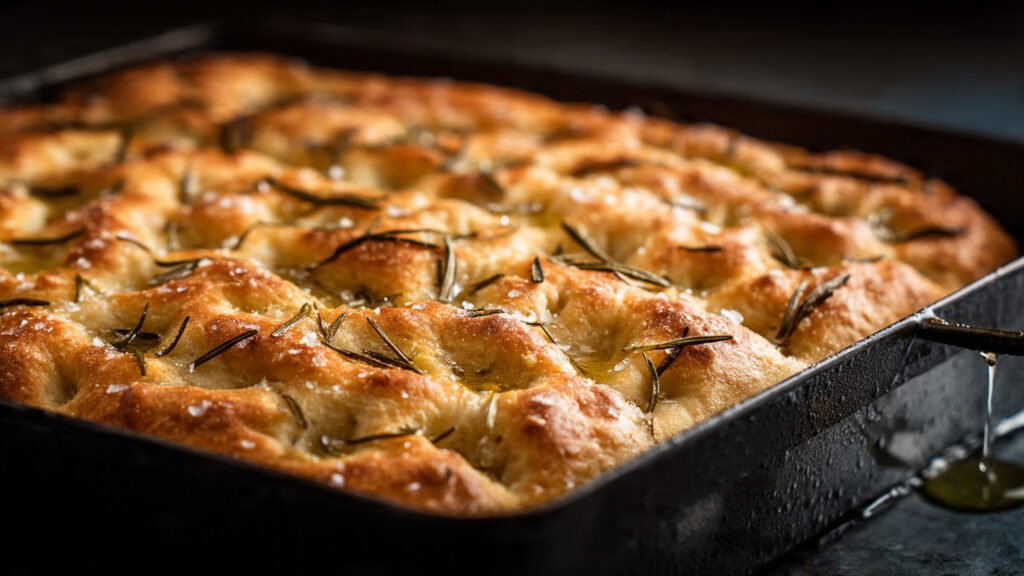
This is not a consolation prize — focaccia from over-fermented sourdough can be genuinely excellent, with deep flavor and a blistered, chewy texture.
Option 4: Discard and start over
If the dough is grey, slimy, or smells genuinely foul rather than just very sour, it’s gone. Don’t bake it. The silver lining: a severely over-fermented starter is not dead — feed it consistently for a few days and it will recover.
What Over-Fermented Bread Looks Like After Baking
If you baked dough that was over-fermented without realizing it, here’s what to look for in the finished loaf:
- Flat loaf with little to no oven spring
- Dense, compressed crumb — especially toward the bottom of the slice
- Pale, uneven crust — may have dark spots but no overall golden-brown color
- Scores didn’t open — they melted into the surface instead of blooming
- Overly sour, harsh flavor — more acidic than tangy
- Brittle or oddly hard crust with a faint corn-like smell
If this sounds like your last loaf, the fix for next time is ending bulk fermentation earlier — see the sourdough bulk fermentation chart for timing guidance by temperature.
How to Prevent It Next Time
Stop going by time — watch the dough
Recipes give time ranges, but your kitchen temperature, starter strength, and flour type all affect the actual pace. A dough that should take 5 hours at 75°F can be done in 3 hours if your kitchen is 80°F. The clock is a rough guide. The dough is your actual timer.
Know when to stop: 50–75% rise, not a full double
For most sourdoughs, you should shape when the dough has risen 50–75% — not when it’s doubled. Waiting for a full double during bulk fermentation is the single most common reason bakers end up with over-fermented dough. For a warm dough (78–80°F), shape even earlier — around 30–40% rise — because fermentation continues aggressively during preshaping, bench rest, and the early minutes of cold proofing.
If in doubt, put it in the fridge
If something comes up and you can’t tend to your dough, moving it to the fridge is not ideal, but it will dramatically slow fermentation and buy you time. This is always a better option than letting it over-ferment on the counter.
Use the aliquot jar method
Take a small sample of dough in a straight-sided jar at the start of bulk fermentation. Mark the starting level with a rubber band or piece of tape. Watch the jar — it’s much easier to accurately measure rise percentage in a small straight-sided container than in a wide bowl.
Related Guides
- Sourdough Bulk Fermentation Chart — Full temperature and timing reference
- Signs Bulk Fermentation Is Done
- How Long Does Bulk Fermentation Take?
- Why Is My Bulk Fermentation So Slow?
- Overnight Bulk Fermentation
- How to Fix Overproofed Sourdough
FAQ
What happens if sourdough bulk fermentation goes too long?
The gluten network breaks down from enzyme activity, the yeast exhausts the available sugars, and the dough becomes slack and sticky. The result after baking is a flat, dense loaf with a pale crust, poor oven spring, and an overly sharp sour flavor.
Can I still bake over-fermented sourdough dough?
Yes, depending on how far over it is. Mildly over-fermented dough can be shaped and baked immediately with a shortened final proof. Moderately over-fermented dough bakes well in a loaf pan. Severely over-fermented dough is best baked as focaccia. Only discard if it smells genuinely rotten rather than just very sour.
How do I know if my bulk fermentation went too long?
Look for a dough that has more than doubled, has a flattened or sunken surface, feels extremely slack and sticky, tears easily when stretched, and smells sharply acidic or alcoholic. Any of these signs point to over-fermentation.
Can I put over-fermented dough in the fridge to slow it down?
Refrigerating it will slow further fermentation, but it won’t undo damage that’s already happened. If the gluten has already weakened significantly, the cold won’t restore it. Your best move with mildly over-fermented dough is to shape and bake immediately rather than refrigerating.
Why did my sourdough bulk ferment too fast?
The most common causes are a warm kitchen, too much starter in the recipe, or a very active starter combined with a warm dough temperature. At 78–80°F with 20% starter, bulk fermentation can finish in 3–4 hours. If you’re used to a slower kitchen, a warm day can catch you off guard.
How much should sourdough rise during bulk fermentation?
For most sourdoughs, aim for a 50–75% volume increase — not a full double. At warmer dough temperatures (78°F+), shape even earlier at 30–40% rise, because fermentation continues during preshaping and the early stage of cold proofing. Waiting for the dough to fully double during bulk is the most common cause of over-fermentation.