Clarification: This recipe contains no commercial baker’s yeast. It relies 100% on wild yeast from your sourdough starter for leavening. This provides superior gut health benefits and easier digestion compared to store-bought yeast breads.
- Is Sourdough Bread Yeast Free?
- How Sourdough Works Without Commercial Yeast
- Sourdough Recipes You Can Make Without Commercial Yeast
- Sourdough vs Regular Yeast Bread
- Why No-Yeast Sourdough Is Better for Gut Health
- Master Recipe
- 24-Hour Baking Timeline
- Starter Strength Diagnostics
- Frequently Asked Questions
Is Sourdough Bread Free From Commercial Yeast?
This is one of the most common questions about sourdough — and the answer requires a small clarification. Sourdough is free from commercial yeast (instant yeast, active dry yeast, or baker’s yeast packets). However, it does contain wild yeast — the naturally occurring yeast that lives in your sourdough starter alongside lactic acid bacteria.
So when people search for “sourdough bread without yeast” or “sourdough bread no yeast,” they almost always mean without commercial yeast — and traditional sourdough fits that description perfectly. For a deeper explanation of this distinction, see our guide on is sourdough bread yeast free.
| Type of Yeast | In Commercial Bread? | In Sourdough? |
|---|---|---|
| Commercial yeast (instant/active dry) | Yes | No |
| Wild yeast (from starter) | No | Yes |
| Lactic acid bacteria | No | Yes |
How Sourdough Rises Without Commercial Yeast
If you’re searching for sourdough bread no yeast, you’re likely trying to bake bread without using commercial yeast packets. The good news is that traditional sourdough never requires instant yeast or active dry yeast. Instead, sourdough relies on natural wild yeast cultivated in a sourdough starter.
When flour and water combine in a starter, natural microorganisms begin multiplying — primarily wild yeast and Lactobacillus bacteria. Wild yeast produces carbon dioxide, which causes dough to rise. Bacteria produce organic acids, which create flavor, strengthen gluten, and pre-digest the bread. This natural ecosystem completely replaces commercial yeast.
The most common reason no-yeast sourdough fails is a weak or immature starter. Before attempting any recipe below, confirm your starter doubles reliably within 4–6 hours of feeding. If it doesn’t, no recipe will compensate — see our guide on what to do when your starter won’t double first.
If you don’t yet have a starter, begin with our sourdough starter recipe and use our starter feeding chart to get it strong before baking.
Sourdough Bread Recipes Without Commercial Yeast
With an active starter, you can make far more than a basic artisan loaf. Here are the most practical no-commercial-yeast sourdough recipes, organised by time commitment:
| Recipe | Time | Best For |
|---|---|---|
| Classic Artisan Sourdough Loaf (this page) | 24–48 hrs | Open crumb, crispy crust, everyday bread |
| Sourdough Focaccia | Same day or overnight | Olive oil, herbs, beginner-friendly |
| Sourdough Pizza Dough | Same day (4–6 hrs) | Thin crust, quick weeknight option |
| Sourdough Flatbread | 1–2 hrs | Fastest option, uses discard |
| Sourdough Discard Pancakes | 30 mins | Uses leftover or overfermented dough |
Same-day vs. overnight: Flatbreads, focaccia, and pizza work same-day with an active starter. Full loaves benefit from an overnight cold ferment — the extra time develops better flavor, a more open crumb, and easier scoring. If you’re new to sourdough, start with flatbread or focaccia to build confidence before tackling an artisan loaf.
Sourdough vs. Regular Yeast Bread: What’s Actually Different?
Regular Yeast Bread
- Uses instant or active dry yeast
- Rises quickly (1–2 hours)
- Mild flavor
- Predictable timing
Sourdough Bread — No Commercial Yeast Needed
- Uses wild yeast from starter
- Ferments slowly (4–24 hours)
- Develops complex flavor
- Improves gluten structure naturally
Commercial yeast forces rapid gas production. Wild yeast works gradually, strengthening dough over time. This slow fermentation process is what gives authentic sourdough its open crumb and crisp crust.
Why “No Yeast” Sourdough Is the Gold Standard for Gut Health
| Feature | Commercial Yeast (Instant) | Wild Sourdough (No Yeast) |
| Source | Lab-grown Saccharomyces cerevisiae | Natural airborne yeast & bacteria |
| Rise Time | Fast (1–2 hours) | Slow (6–12+ hours) |
| Digestion | Harder to digest (high gluten) | Pre-digested (Gut Friendly) |
| Flavor | Bland / Yeasty | Complex / Tangy |
| Additives | Often contains preservatives | 3 Ingredients Only (Flour, Water, Salt) |
Most people searching for a “no yeast” recipe are looking for relief from digestive distress. Commercial instant yeast forces bread to rise in under two hours, leaving heavy gluten and anti-nutrients like phytic acid completely intact.
By using this 3-ingredient wild yeast method, you allow for a 24-hour fermentation that pre-digests the flour for you. This is why people who suffer from acid reflux often find they can eat this specific bread with zero heartburn — see our complete guide on sourdough bread for acid reflux. The same fermentation process explains why sourdough helps with constipation and why sourdough doesn’t cause bloating. For the complete health picture, read our guide on whether sourdough bread is healthy for you.
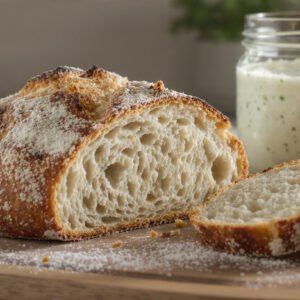
Easy 3-Ingredient Sourdough Bread Recipe (No Commercial Yeast)
Ingredients
- 500 g Bread Flour Organic unbleached is best for wild yeast.
- 350 g Warm Water Filtered water is preferred as chlorine can hurt the natural bacteria.
- 10 g Sea Salt Adds flavor and regulates the fermentation.
- Note: You will also need 100g of active Sourdough Starter Wild Yeast Culture.
Instructions
- The “No-Yeast” Mix
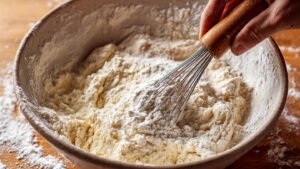
- In a large bowl, whisk your active starter into the warm water until it looks milky. Add your flour and salt. Mix by hand until a shaggy dough forms and no dry flour remains.

- The Bulk Fermentation (The Magic Window)
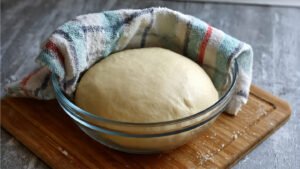
- Cover the bowl with a damp cloth and let it sit at room temperature for 8–12 hours. Unlike commercial bread, we are waiting for the Lactic Acid Bacteria (LAB) to create organic acids. This long window is what stimulates the Migrating Motor Complex (MMC) in your gut. If you’ve struggled with regularity, choosing the right grain is key; see our comparison of sourdough vs whole wheat constipation to see which flour works best for your motility.
- Stretch and Fold
- Every 30 minutes for the first 2 hours, reach under the dough and pull it over itself. This strengthens the natural gluten without the need for intense kneading or chemical dough conditioners found in commercial "no yeast" supermarket breads.
- The Cold Proof (Maximum Digestibility)
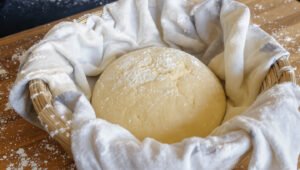
- Shape your dough into a ball and place it in a proofing basket or bowl lined with a floured towel. Place it in the fridge for another 12–24 hours. This "Cold Proof" is where the bacteria neutralize the phytic acid that typically causes bloating and gas.

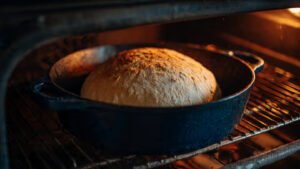
- Preheat a Dutch oven at 450°F (230°C). Carefully place your dough inside, score the top with a sharp knife, and bake covered for 20 minutes. Remove the lid and bake for another 20–25 minutes until the crust is a deep golden brown.
Notes
Master Recipe: Classic Sourdough Bread Without Commercial Yeast
Below is a traditional method for baking sourdough bread without commercial yeast using only active starter, flour, water, and salt. Before starting, make sure your starter passes the doubling test — see our starter feeding and maintenance guide if you are not sure.
How to Tell When Your No-Yeast Sourdough Dough Is Ready
When baking sourdough bread without commercial yeast, timing is based on fermentation — not the clock. Look for a 50–75% rise during bulk fermentation, visible bubbles along the surface, dough that feels airy but elastic, and a slow spring-back during the bread poke test. Underproofed dough produces dense bread. Overproofed dough collapses in the oven. For the full visual guide on reading your dough, see our bulk fermentation chart.
24-Hour No-Yeast Sourdough Bread Timeline
When baking sourdough bread without commercial yeast, timing is flexible — but structure matters. Unlike commercial yeast bread, sourdough follows a fermentation rhythm rather than a strict clock. Here is a clear 24-hour roadmap you can follow.
Evening Before Baking — Starter Preparation (8:00 PM)
Feed your starter at a 1:2:2 ratio (50g starter, 100g flour, 100g water). Let it sit at room temperature overnight. By morning it should have doubled, appear bubbly, and smell mildly tangy. Use our sourdough starter chart to confirm your ratio is right for your kitchen temperature.
Morning — Mix Dough (8:00 AM)
Combine flour, water, and active starter. Mix until no dry flour remains. Let rest 30 minutes (autolyse). This hydrates the flour fully and begins gluten development — improving dough extensibility without kneading. For a full walkthrough, see our guide on how to mix sourdough dough.
Mid-Morning — Stretch and Fold (8:30–10:30 AM)
Perform 3–4 sets of stretch and folds spaced 30 minutes apart. Each round: gently stretch one side of dough upward, fold it over itself, rotate bowl and repeat. This builds strength without heavy kneading. See our complete stretch and fold schedule for beginners.
Afternoon — Bulk Fermentation (10:30 AM–2:30 PM)
Let dough rise at 68–75°F. You are not waiting for it to double — look for a 50–75% size increase, small bubbles on the surface, and a slight jiggle when the bowl is shaken. Our bulk fermentation chart shows exact timing for your kitchen temperature, and our guide on how to know when bulk fermentation is done covers all the visual signs.
Late Afternoon — Shaping (2:30 PM)
Turn dough onto lightly floured surface. Shape gently into a round and rest 20–30 minutes. Then perform final shaping, creating surface tension. See our guide on how to shape a sourdough boule and batard.
Evening — Cold Proof (3:00 PM onward)
Place dough in a proofing basket, cover, and refrigerate 8–12 hours. Cold fermentation enhances flavor, improves scoring, and strengthens gluten. For the full cold proofing guide, see our guide on how long you can cold proof sourdough.
Next Morning — Bake
Preheat oven to 475°F with Dutch oven inside (30–45 minutes minimum). Transfer dough onto parchment, score with a sharp blade, and bake 20 minutes covered then 20 minutes uncovered. Cool at least 1 hour before slicing. Learn how long sourdough bread lasts and the best way to store it.
Why This Timeline Works
This schedule allows proper gluten development, balanced fermentation, strong oven spring, and controlled flavor development. Commercial yeast speeds up bread. This fermentation-based timeline is what makes sourdough bread without commercial yeast structurally superior and more flavorful.
Starter Strength Diagnostics: Is Your Starter Strong Enough?
When baking sourdough bread without commercial yeast, most failures trace back to one issue: a weak starter. Because you are not using commercial yeast, your entire rise depends on the strength of your wild yeast culture.
1. The Doubling Test (Most Reliable)
After feeding your starter at room temperature (68–75°F), it should double in size within 4–6 hours, show consistent bubbles throughout, and have a domed top before it begins to fall. If it takes more than 8 hours to double, your starter is not strong enough yet. See our starter not doubling guide for fixes.
2. Texture Check
A mature, healthy starter should feel airy and slightly elastic, thick but pourable, and web-like inside when stirred. If your starter looks watery or separated, it may need more frequent feedings. If it smells harsh or sharply alcoholic, it is likely hungry.
3. The Float Test (Helpful — But Not Final)
Drop a small spoonful of starter into water. If it floats, it contains enough gas. However, a starter can float and still be underdeveloped, and a starter can sink and still bake decent bread. Use the float test as a secondary indicator — the doubling test is far more reliable.
4. Feeding Ratio for a Weak Starter
If your starter feels weak, feed at a 1:3:3 ratio for 2–3 consecutive feedings. Higher feed ratios refresh the yeast population, reduce acidity, and increase fermentation power. Our sourdough starter feeding chart covers every ratio and scenario. If your starter smells like acetone, see our guide on fixing a starter that smells like acetone.
5. Temperature Check
Wild yeast thrives at 68–75°F (20–24°C). Below 65°F, fermentation slows dramatically. If your kitchen is cool, try placing your starter near an oven light, using a proofing box, or wrapping the jar in a towel. See our guide on how to keep sourdough starter warm for more options.
Signs Your Starter Is Ready to Bake Without Commercial Yeast
- Doubles reliably within 4–6 hours of feeding
- Smells mildly tangy and yeasty — not sharp or like acetone
- Holds structure when stirred
- Peaks and slowly begins to fall
Frequently Asked Questions
Do you need yeast to make sourdough bread?
No. Traditional sourdough does not need commercial yeast. Your sourdough starter contains wild yeast and lactic acid bacteria that leaven the bread entirely through natural fermentation. Commercial yeast is optional — and adding it actually reduces the flavor, digestibility, and gut health benefits that make sourdough worth baking in the first place.
What sourdough bread recipes can you make without commercial yeast?
With an active starter, you can make virtually any bread without commercial yeast — classic artisan sourdough loaves, sandwich bread, focaccia, sourdough flatbread, discard pizza dough, and more. Each relies on wild yeast from the starter for leavening. Pizza dough and flatbreads work same-day; full loaves benefit from an overnight cold ferment for best flavor and crumb.
Can you make sourdough bread without yeast?
Yes — traditional sourdough never uses commercial yeast. It relies entirely on wild yeast from a sourdough starter, which leavens the dough through natural fermentation over 12–48 hours. The result is a 3-ingredient loaf (flour, water, salt plus starter) that is easier to digest, lower GI, and better for gut health than any commercial yeast bread. For the full explanation, see our guide on whether sourdough is truly yeast free.
Can you make sourdough bread without a starter or yeast?
Not in the traditional sense — a sourdough starter is the source of the wild yeast that leavens the bread. Without a starter, you would need to add commercial yeast. Building a starter from scratch takes 5–7 days and requires only flour and water. Start with our sourdough starter recipe — it is simpler than most people expect. Alternatively, our no-yeast sourdough flatbread uses discard and baking soda for a quick same-day option.
Is sourdough bread yeast free?
Sourdough is free from commercial yeast but does contain wild yeast — the naturally occurring yeast in your starter. If you are avoiding all yeast for medical reasons (such as a candida protocol), sourdough is not yeast-free. If you are avoiding commercial yeast for digestive or health reasons, traditional sourdough is an excellent choice. See our complete guide on is sourdough bread yeast free.
Does all sourdough bread have yeast in it?
No — traditional sourdough relies on wild yeast naturally present in the starter. Some commercial sourdough breads add baker’s yeast for faster fermentation, but authentic sourdough does not require it. Always check the ingredient list — if it contains commercial yeast or vinegar, it is not traditionally fermented.
Can diabetics eat sourdough bread with no commercial yeast?
Yes, in most cases. Traditionally fermented sourdough has a glycemic index of 48–68 compared to white bread’s 70–75, and research shows it produces a 25–30% lower blood glucose response than conventional bread. See our complete guide on does sourdough bread spike blood sugar.
Is sourdough without commercial yeast healthier?
Yes — significantly. The slow wild fermentation reduces phytic acid by 50–90%, breaks down FODMAPs that cause bloating, lowers the glycemic index, and partially pre-digests gluten. None of these benefits occur in fast commercial yeast bread. For the complete health breakdown, see our guide on whether sourdough bread is healthy for you and our overview of sourdough gut health benefits.
Why is my sourdough no yeast bread dense?
The most common causes are a weak starter, bulk fermentation cut too short, or dough that went into the fridge underproofed. See our guides on why sourdough is dense and why sourdough crumb turns out gummy for full diagnosis and fixes.
How long does it take to make sourdough bread without commercial yeast?
From start to finish, a naturally leavened sourdough loaf takes 24–48 hours — but most of that is hands-off fermentation time. Active work time is roughly 30–45 minutes. A typical schedule: mix in the morning, bulk ferment 4–6 hours, shape in the afternoon, cold proof overnight, and bake the next morning. The starter preparation the evening before adds another step but only takes minutes.
Can I make sourdough bread without yeast in one day?
Yes — same-day no-yeast sourdough is possible with a strong, active starter. Skip the overnight cold proof and bake after bulk fermentation and shaping (roughly 8–10 hours total). The flavor will be milder and the crumb slightly tighter than an overnight loaf, but it is a fully viable option. Flatbread and focaccia are even faster — both can be done in 2–4 hours with an active starter.
Related Posts
Master the exact techniques that prevent common sourdough mistakes. Learn the bread poke test to nail perfect proofing every time.
Understand why your bread turns out dense and wet by reading about why sourdough gets gummy and how to prevent it.
If fermentation goes too long, discover practical solutions in how to fix overproofed dough — including focaccia and cold-shaping techniques.
Build your foundation by learning the difference between bulk fermentation and final proofing — two critical stages every baker must master.
Master the timing by learning how long you can cold proof sourdough for perfectly fermented bread every time.