Yes — for most regular sourdough bakers, the Brod & Taylor proofer is worth it. If your kitchen temperature swings more than 5°F between seasons, or you bake at least once a week, the consistency improvement is real and immediate. If your kitchen holds steady at 72–76°F year-round and you bake occasionally, the DIY methods — microwave steam chamber, oven light, insulated cooler — may give you 80% of the results for free. The proofer earns its price by removing temperature as a variable entirely, session after session, regardless of season.
For detailed specs, temperature precision, and energy cost breakdowns, see our complete Brod & Taylor review with 3+ years of testing data.
What the Brod & Taylor Proofer Actually Does
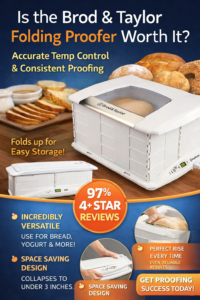
The Brod & Taylor Folding Proofer is a collapsible, temperature-controlled box that maintains a precise, stable environment for fermentation. You set a temperature — typically 75–78°F for sourdough bulk fermentation — and it holds that temperature consistently for the entire session, regardless of what your kitchen is doing around it.
Key specs worth knowing:
Temperature range: 70°F–195°F (21°C–90°C), covering everything from slow bulk fermentation to yogurt making.
Capacity: Fits two large bannetons, an 8-quart mixing bowl, or standard sourdough containers.
Footprint when collapsed: About 3 inches thick — slides behind a cabinet door or next to baking sheets.
Humidity: Includes a water tray that creates gentle humidity inside, preventing a dry skin from forming on your dough surface during long ferments.
Heat source: Radiant heat — no direct bottom heat that could over-ferment the base of your loaf.
Noise: Completely silent. No fan, no motor.
The collapsible design is genuinely one of its best features. Most commercial proofing boxes are permanent counter fixtures. This one assembles in under 30 seconds and folds flat when you’re done — a significant advantage for home kitchens with limited space. For a full performance breakdown, see the complete Brod & Taylor proofer review.
Who Benefits Most From a Folding Proofer
You will likely notice a significant improvement if:
Your kitchen drops below 68°F in winter. At that temperature, wild yeast activity slows dramatically and acidity builds faster than gas production — meaning your dough develops sourness but not structure. No amount of extra time fully compensates for this imbalance, as explored in the sourdough fermentation triangle.
You bake sourdough once a week or more. The proofer’s value compounds with frequency — you stop losing bakes to ambient temperature shifts and start baking to a reliable schedule. If your dough takes 4 hours at 78°F, it takes 4 hours every single time.
You struggle with overproofed or underproofed results and can’t pinpoint why. If your loaves are inconsistent despite following the same recipe, ambient temperature variation is often the culprit — not your technique.
You want to bake on a predictable schedule. A proofer lets you choose your fermentation speed rather than letting the season decide. Running late? Set it slightly cooler to slow things down. Need a faster bake? Nudge the temperature up a degree or two.
When You Probably Don’t Need One
If your kitchen genuinely holds between 72–76°F year-round without much variation, you’re already operating near the ideal sourdough proofing temperature and may not notice enough of a change to justify the cost.
If you bake once or twice a month, the free DIY methods covered in the keep sourdough dough warm guide — microwave steam chamber, oven light, insulated cooler — are enough for occasional bakes and cost nothing. The proofer is built for repetition, not sporadic use.
If budget is the primary concern, see the cheap alternatives to the Brod & Taylor proofer before committing — several options deliver meaningful temperature control at a fraction of the price.
For a head-to-head comparison of the most popular free method versus the proofer, read Brod & Taylor proofer vs. oven light — including where the oven light method fails and why LED ovens have made it unreliable.
What Actually Improves (And What Doesn’t)
Bakers who switch to a proofer consistently report improvements in four specific areas:
Fermentation predictability. The same dough, same starter percentage, same recipe — arrives at the same point at the same time, session after session. This is the proofer’s single biggest contribution. It effectively removes seasonal variability from your process entirely.
Oven spring and crumb structure. Dough fermented at a consistent 75–78°F develops gluten strength and gas retention more evenly than dough that has experienced temperature swings. Many bakers report noticeably better oven spring after switching — not because the proofer is magic, but because fermentation is finally completing properly.
Fewer wasted bakes. Overproofed and underproofed loaves drop dramatically. When temperature is controlled, the dough responds the way the recipe expects. Understanding the signs still matters — the sourdough poke test visual guide helps you read dough readiness accurately regardless of method.
Scheduling flexibility. You control fermentation speed rather than working around what your kitchen happens to be doing that day.
What doesn’t change: The proofer won’t fix a weak or immature starter, an incorrect hydration, poor shaping technique, or an underbaked loaf. If your sourdough is dense because of starter issues, the proofer maintains that problem at a more consistent temperature. It’s a fermentation environment tool — not a baking fix-all.
Beyond Bread: Other Uses That Add Value
The proofer’s temperature range extends well beyond sourdough. Many bakers use it for homemade yogurt (requires a stable 100–110°F hold for several hours), tempering chocolate, proofing yeasted doughs, culturing kefir, and keeping dishes warm before serving. These secondary uses improve the cost-per-use calculation meaningfully if you ferment or culture anything else at home.
Note: the slow cooker function works best with flat-bottomed stainless steel vessels — cast iron Dutch ovens do not heat efficiently inside the proofer at slow cooker settings.
Why Controlled Temperature Changes Everything
Sourdough fermentation is not just about time — it’s about the relationship between temperature, yeast activity, and bacterial acid production. A 5°F swing in ambient temperature can change your bulk fermentation time by 1–2 hours and shift your dough’s flavor profile significantly. This is why two bakers following the same recipe get different results in different kitchens. Understanding how dough temperature affects fermentation and what the desired dough temperature (DDT) concept means for your baking will help you get the most out of a proofer — or out of any warming method you use.
For a full breakdown of fermentation ranges and timing by temperature, see the sourdough proofing temperature guide. If you’re building toward buying, the best proofing boxes for sourdough comparison covers how the Brod & Taylor stacks up against every major alternative at different price points.
Frequently Asked Questions
Is the Brod & Taylor proofer worth the price for occasional bakers?
Probably not. If you bake once or twice a month, the free warming methods — microwave steam chamber, oven with light on, cooler with warm water — give you enough temperature control for occasional bakes. The proofer’s value compounds with frequency. Weekly or more is where it pays off.
Does the Brod & Taylor proofer actually hold temperature accurately?
Yes, with one caveat: the temperature setting controls the food temperature inside, not the air temperature. This is actually more accurate for bread baking, but it means there’s a short learning curve on first use. Independent testing consistently shows minimal drift once the unit stabilizes.
Can it fit two bannetons at once?
Two bannetons fit when stacked vertically using an additional rack or a homemade riser. Side-by-side fitting of two large bannetons is tight and depends on banneton diameter. The unit fits one large banneton (up to 10″) comfortably without modification.
What if my oven already has a proof setting?
Most oven proof settings run 80–100°F — too warm for long bulk fermentation at the ideal 74–78°F range. The Brod & Taylor goes lower and holds more precisely. If your oven’s proof setting is verified at 78°F or below, it may be sufficient — but most are not. See the full proofer vs. oven light comparison for more detail.
Does it work for the starter as well as the dough?
Yes. Many bakers use the proofer for both starter activation and bulk fermentation in the same session. For starter-specific warming strategies that work with or without a proofer, see how to keep sourdough starter warm.
My sourdough is still inconsistent — will this fix it?
Only if temperature is the root cause. If your starter is weak, or your dough isn’t rising even in warm conditions, check why sourdough doesn’t rise in winter and the sourdough starter not doubling guide first — a proofer can’t compensate for an unhealthy starter.