👈 Back to Master Bulk Fermentation Chart — Compare all temperatures (65–85°F)
Jump to another temperature: 70°F • 80°F • Whole Wheat • High Hydration • Beginners
75°F (24°C) represents the ideal temperature for sourdough bulk fermentation. This is the sweet spot where timing becomes predictable, visual cues are reliable, and fermentation moves at a pace that accommodates real-world baking schedules without requiring constant monitoring.
At 75°F, you get the best of both worlds: fermentation completes in a manageable 4-6 hour window while still developing complex flavor. This temperature sits right in the middle of most home kitchens during spring and fall, making it the baseline temperature most sourdough recipes assume when they provide timing estimates.
This guide breaks down everything you need to know about bulk fermenting at 75°F, including precise timing charts, visual readiness cues, troubleshooting strategies, and how to maintain this optimal temperature year-round. For comprehensive coverage of bulk fermentation at all temperatures, see our complete bulk fermentation chart.
🧮 Calculate Your Bulk Fermentation Time
75°F is the ideal temperature for consistent bulk fermentation. Calculate your precise timing with this tool:
Accounts for temperature, starter %, hydration, and flour type
Why 75°F Is the Gold Standard Temperature
When professional bakers and recipe developers write sourdough formulas, they calibrate timing around 75°F dough temperature. This isn’t arbitrary—it’s the temperature that delivers optimal yeast and bacterial activity while maintaining structural integrity throughout the fermentation window.
At 75°F, yeast activity operates at roughly 85-90% of its maximum efficiency. This means fermentation moves quickly enough to finish in a single afternoon or evening, but not so fast that you need to watch it constantly. The 4-6 hour timeline gives you enough flexibility to complete stretch and folds, step away for other tasks, and return to perfectly fermented dough.
Bacterial acid production at 75°F strikes an ideal balance between flavor development and structural preservation. You get sufficient sourness and complexity without the aggressive acidity that develops at cooler temperatures during extended fermentation. The fermentation triangle of time, temperature, and starter percentage achieves perfect equilibrium at this temperature.
Most importantly, 75°F produces consistent, reproducible results. Bake the same recipe at 75°F ten times and you’ll see remarkably similar outcomes. Try that at 65°F or 82°F and variability increases dramatically because small temperature fluctuations have outsized effects at the extremes.
The Complete 75°F Bulk Fermentation Timing Chart
At 75°F dough temperature, expect bulk fermentation to take 4-6 hours for a typical sourdough recipe with 20% starter (based on flour weight). This moderate timeline allows for proper flavor development while maintaining a manageable same-day baking schedule.
Detailed Timing by Starter Percentage at 75°F:
10% Starter (1:10 ratio):
- Expected time: 6-8 hours
- Best for: Extended daytime fermentation, more developed flavor
- Visual cues appear: After 5-6 hours
- Ideal for: Bakers who want slower, more controlled fermentation
15% Starter (1:6.7 ratio):
- Expected time: 5-7 hours
- Best for: Standard daytime baking with moderate pace
- Visual cues appear: After 4-5 hours
- Ideal for: Balanced timing with good flavor complexity
20% Starter (1:5 ratio):
- Expected time: 4-6 hours
- Best for: Most common ratio, highly predictable
- Visual cues appear: After 3-4 hours
- Ideal for: Standard recipes, beginner-friendly timing
25% Starter (1:4 ratio):
- Expected time: 3-5 hours
- Best for: Faster same-day baking
- Visual cues appear: After 2.5-3 hours
- Ideal for: When you need bread by dinner
30% Starter (1:3.3 ratio):
- Expected time: 2.5-4 hours
- Best for: Quick turnaround bakes
- Visual cues appear: After 2 hours
- Ideal for: Emergency bread or compressed schedules
These times assume active, peak-ripeness starter that has doubled within 4-6 hours of feeding. If your sourdough starter isn’t doubling reliably, add 1-2 hours to these estimates or strengthen your starter before attempting bulk fermentation.
Flour type significantly impacts these timings. Whole wheat flour ferments 20-30% faster than white flour even at 75°F, so a 50% whole wheat dough might complete bulk fermentation in 3-4 hours with 20% starter. Check our bulk fermentation chart for whole wheat for specific guidance on whole grain timing.
High hydration doughs (80%+) also ferment faster due to increased enzymatic activity. Refer to our bulk fermentation chart for high hydration dough if working above 80% hydration.
Volume Increase and Visual Cues at 75°F
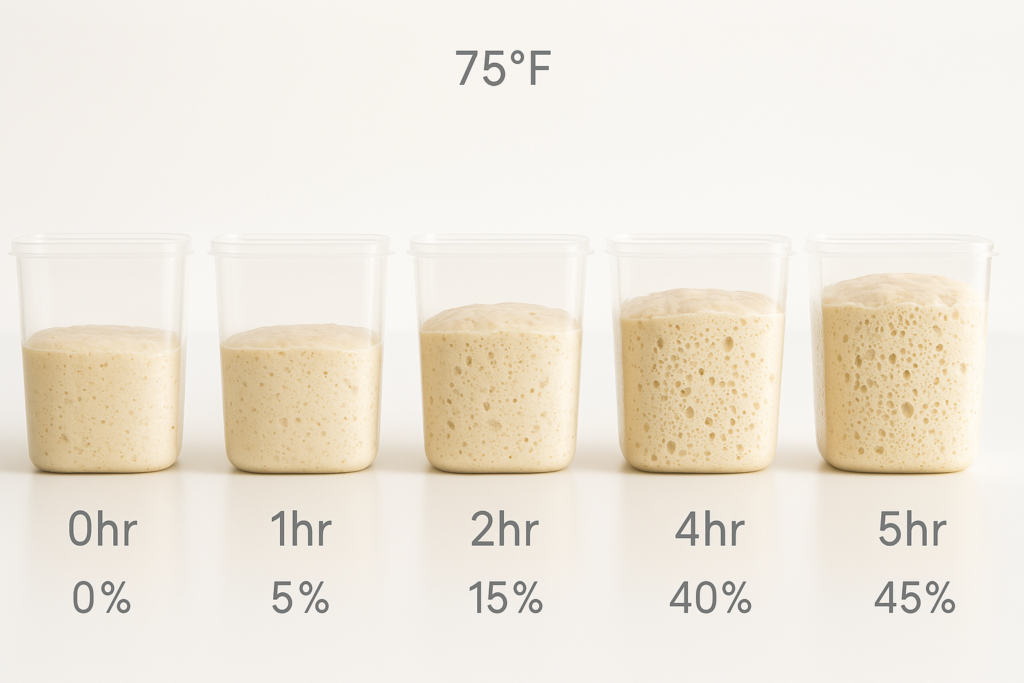
Target a 40-50% volume increase at 75°F before shaping. This moderate rise target reflects the balance between yeast activity and structural integrity at this temperature. Going beyond 50% risks overproofing, while stopping below 40% leaves insufficient gas development for good oven spring.
What 40-50% Rise Looks Like: Place a rubber band around your bulk fermentation container at the starting dough level. At 75°F, your dough should rise to roughly halfway up its original height. If your dough started at 4 inches high, it should reach approximately 5.6-6 inches (40-50% increase). The aliquot method provides the most precise measurement of percentage rise.
The rise at 75°F appears steady and progressive. Unlike the explosive rise at 80°F or the glacial pace at 65°F, fermentation at 75°F moves at a visible but manageable rate. You can actually watch the dough expand in real-time during the final hour.
Critical Visual Indicators at 75°F:
Surface Texture: The dough top should display a pronounced dome—more prominent than you’d see at 70°F but not as aggressive as 80°F. The surface appears smooth and taut with numerous small bubbles visible across the top.
Side Bubbles: Look through your clear container sides. You should see abundant small to medium bubbles distributed throughout the entire dough mass, not just concentrated at the top. At 75°F, bubble formation is vigorous and creates a distinct honeycomb appearance. Learn more about signs your bulk fermentation is done.
Jiggle Test: Gently shake your container side to side. Properly fermented dough at 75°F jiggles assertively as one cohesive mass with visible wobble and bounce. It should feel springy and alive, not stiff or sloshy.
Dome Retention: When you perform stretch and folds during bulk fermentation, the dough should quickly rebuild its domed shape within 15-20 minutes. This rapid recovery indicates active fermentation and good gluten development.
Smell Test: At 75°F, properly fermented dough smells pleasantly tangy and yeasty—not neutral, but not aggressively sour either. If you detect strong alcohol or acetone notes, fermentation has gone too far.
The Science Behind 75°F Fermentation
Understanding the microbial activity at 75°F helps explain why this temperature produces such reliable results. At this temperature, both Saccharomyces cerevisiae (yeast) and Lactobacillus species (bacteria) operate in their optimal efficiency zones. This is fundamental to understanding how dough temperature affects fermentation.
Yeast Activity at 75°F: Yeast reproduction and CO2 production occur at approximately 85-90% of maximum capacity at 75°F. This high activity level means robust gas production without the structural degradation that occurs at higher temperatures. Cell division happens rapidly enough to create sufficient leavening power within the 4-6 hour window.
Bacterial Activity at 75°F: Lactic acid bacteria thrive at 75°F, producing both lactic and acetic acids at a steady, controlled rate. The ratio of these acids at this temperature creates the classic sourdough tang without overwhelming sourness. This balanced acid production also contributes to gluten strengthening through crosslinking reactions.
The Flavor Profile at 75°F: Bread fermented at 75°F develops moderate sourness with complex underlying flavors—earthy, slightly nutty, with subtle sweetness from residual sugars. This is what most people think of as “classic sourdough” flavor. If your sourdough isn’t sour enough, cooler fermentation or longer times help, but 75°F represents the mainstream flavor profile.
Enzyme Activity at 75°F: Amylase enzymes work efficiently at 75°F, steadily converting starches into fermentable sugars throughout bulk fermentation. This continuous sugar supply sustains yeast and bacterial populations without creating excess sweetness in the final bread. Protease enzymes remain active but controlled—breaking down gluten just enough to improve extensibility without compromising structure.
Same-Day Baking Schedule at 75°F
The 4-6 hour bulk fermentation window at 75°F enables practical same-day baking schedules that fit around work, family commitments, and other obligations. This makes 75°F the most accommodating temperature for busy home bakers.
Morning Start Schedule:
8:00 AM: Feed your starter
12:00 PM: Mix dough (starter at peak), begin bulk fermentation
12:30 PM: First stretch and fold
1:00 PM: Second stretch and fold
1:30 PM: Third stretch and fold
2:00 PM: Fourth stretch and fold (optional)
4:00-6:00 PM: Shape dough when bulk fermentation reaches 40-50% rise
Next morning: Bake after overnight cold proof
Afternoon Start Schedule:
2:00 PM: Mix dough, begin bulk fermentation
2:30-4:00 PM: Complete stretch and fold sets
6:00-8:00 PM: Shape when ready
Next day: Bake after cold proof
Temperature Management: Most homes maintain 72-76°F during spring and fall, making 75°F dough temperature easy to achieve and maintain. Use water at 78-80°F during mixing to account for cooler flour temperature and achieve a starting dough temp of 75°F.
If your kitchen runs slightly warm (77-78°F), reduce starter percentage to 15% to extend bulk fermentation into the 5-6 hour range. If your kitchen runs cool (72-73°F), use 25% starter to compress timing to 3-4 hours. A proofing box eliminates these calculations by maintaining exact temperature regardless of ambient conditions.
Troubleshooting 75°F Bulk Fermentation
Problem: Bulk fermentation taking 7-9+ hours at 75°F
This indicates weak starter strength, not temperature issues. At 75°F with healthy 20% starter, bulk should never exceed 6.5 hours.
Solution: Test your starter by feeding it at 1:1:1 ratio and watching for doubling. It should double within 4-6 hours at room temperature. If it takes 8+ hours or doesn’t double at all, spend a week strengthening it with twice-daily feedings before attempting another bulk fermentation. Read our guide on how to strengthen weak sourdough starter for the complete protocol.
Problem: Dough rising too quickly, reaching 50% in 2-3 hours
Your actual dough temperature likely exceeds 75°F. Even 2-3 degrees makes a significant difference in fermentation speed.
Solution: Measure your actual dough temperature with an instant-read thermometer immediately after mixing. If it reads 78-80°F, that explains the accelerated timeline. Next time, use cooler water (70-72°F) during mixing to hit your 75°F target. Alternatively, reduce starter to 15% to slow fermentation back into the 5-6 hour window.
Problem: Inconsistent timing from bake to bake
Seasonal temperature fluctuations or inconsistent starter feeding schedules create variability even when targeting 75°F.
Solution: Measure and log your dough temperature at the start of every bulk fermentation. Track actual bulk completion times alongside dough temp. After 5-10 bakes, you’ll see patterns: “at 74°F, my bulk takes 5 hours; at 77°F, it takes 4 hours.” This personal database becomes more valuable than any chart. Compare proofer vs oven light methods for temperature control.
Problem: Dough passes windowpane test at 3 hours but shows minimal rise
Gluten development and fermentation are two separate processes. The windowpane test only measures gluten strength, not fermentation progress.
Solution: Continue bulk fermentation until the dough reaches 40-50% rise regardless of windowpane test results. Gluten development typically completes in 2-3 hours at 75°F, but fermentation needs the full 4-6 hours. The windowpane test is a secondary confirmation, not a signal to stop. Review our sourdough folding techniques guide to ensure you’re building adequate strength during stretch and folds.
Problem: Dough develops large irregular bubbles and smells strongly sour
You’ve pushed past optimal bulk fermentation into overproofing territory. The large bubbles indicate CO2 has begun escaping from a degrading gluten network.
Solution: Shape immediately even if you’re only at hour 3 or 4. The visual signs trump timing estimates. Next time, check your dough every 30 minutes after the 3-hour mark and shape when you see 40-50% rise with a domed surface and uniform small bubbles. If you consistently struggle with bulk fermentation going too long, reduce your starter percentage.
Adjusting Other Variables at 75°F
Water Temperature Strategy: To achieve 75°F dough temperature when your kitchen is 72°F, use water at 78-80°F during mixing. The slight warmth compensates for cooler flour (typically stored at room temperature or below) and ensures your starting dough hits the target temperature. The dough will maintain 75°F throughout bulk fermentation in a 72-74°F environment.
Flour Selection Impact: Bread flour (12-13% protein) performs optimally at 75°F, developing strong gluten structure during the 4-6 hour window without excessive toughness. See our guide on best flour for sourdough beginners for specific brand recommendations.
All-purpose flour (10-11% protein) works well at 75°F but may require an additional stretch and fold set to achieve comparable strength. The lower protein content means less gluten to develop, so mechanical strength-building becomes more important.
Whole wheat flour accelerates fermentation by 20-30% at any temperature due to higher enzyme content and mineral availability. At 75°F with 50% whole wheat, expect bulk fermentation to complete in 3-4 hours with 20% starter. Monitor closely after the 2.5-hour mark.
Hydration Considerations: Standard hydration (70-75%) works perfectly at 75°F with the timing charts above. Higher hydration (75-80%) may shorten bulk fermentation by 30-45 minutes as the increased water content enhances enzymatic activity and yeast mobility. Learn more about sourdough hydration percentage and its effects on fermentation.
Lower hydration (65-70%) extends bulk fermentation by 30-60 minutes because the stiffer dough limits yeast movement and gas expansion. If you prefer working with lower hydration dough, budget 5-7 hours for bulk fermentation at 75°F with 20% starter.
When 75°F Is Perfect (and When It’s Not)
Best Use Cases for 75°F:
- Same-day baking schedules with afternoon or evening shaping
- First-time sourdough bakers learning fermentation cues
- Spring and fall baking when ambient temperatures naturally support 75°F
- Recipe testing and development (most formulas assume 75°F)
- Bakers seeking classic sourdough flavor without extreme tang
When to Choose Different Temperatures:
- Overnight bulk fermentation: Use 70°F or lower for 8-10 hour timing
- Quick 2-3 hour bulk: Increase to 80°F with reduced starter
- Maximum flavor complexity: Drop to 65-70°F for extended fermentation
- Very weak starter: Increase to 78-80°F to boost activity
Temperature Control Investment: If your kitchen temperature fluctuates more than 5 degrees throughout the day, a proofing box provides consistency. Otherwise, 75°F is achievable in most homes during spring and fall without equipment. Compare options in our cheap alternatives to Brod and Taylor proofer guide.
Expert Tips for 75°F Success
Use the Aliquot Jar Method: Transfer 50g of dough to a narrow straight-sided jar immediately after mixing. This sample ferments identically to your main dough but allows precise percentage rise measurement without disturbing the bulk. When the aliquot reaches 45%, your main dough is ready to shape. Learn the full aliquot method for sourdough.
Container Selection Matters: Use a straight-walled container with milliliter markings to track rise percentage accurately. Cambro-style deli containers work perfectly. See our bulk fermentation container guide for specific recommendations and sizing calculations.
The 3-Hour Check-In: At 75°F with 20% starter, significant fermentation activity becomes visible around hour 3. Set a timer and check your dough at the 3-hour mark. You should see 20-25% rise, increased surface bubbles, and a slight dome forming. If you see minimal change, give it another hour and reassess. If you see 40%+ rise already, shape within the next 30-60 minutes.
Stretch and Fold Timing: Complete 3-4 sets of stretch and folds during the first 2 hours of bulk fermentation at 75°F. Space them 30 minutes apart. After the 2-hour mark, leave the dough undisturbed to allow gas retention and structure development. Review proper technique in our stretch and fold schedule for beginners.
Document Everything: Keep a simple spreadsheet: date, actual dough temp at start, starter percentage, flour type, bulk completion time, and outcome quality (1-10 rating). After 10 bakes, patterns emerge that dial in your personal timing at 75°F. Your specific flour, water, and starter create a unique fermentation fingerprint.
The Surface Tension Test: At 75°F, properly fermented dough shows visible surface tension—the top looks taut and slightly shiny rather than slack or wet. If you gently press a finger on the surface, it should slowly spring back halfway. Complete spring-back means underfermented; no spring-back means overfermented.
Seasonal Adjustments for Maintaining 75°F
Summer (Kitchen 78-82°F): Use cold water (65-68°F) during mixing to bring dough temperature down to 75°F at the start. Even if ambient temperature is 80°F, your dough will hold 75-76°F for the first 2-3 hours, which is sufficient to complete the critical early fermentation phase. Alternatively, ferment in a cooler room (basement) or use a proofer set to 75°F. If baking in hot weather, see our guide on bulk fermentation in hot kitchens.
Winter (Kitchen 65-68°F): Use warm water (85-90°F) during mixing to achieve 75°F starting dough temperature. Place your bulk container in an oven with just the light on (no heat), which typically maintains 75-78°F. Check after 1 hour to confirm temperature hasn’t climbed above 78°F. Learn more winter strategies in our sourdough not rising in winter guide.
Spring/Fall (Kitchen 70-75°F): These seasons naturally support 75°F fermentation with minimal intervention. Use room temperature water (72-75°F) during mixing. Your dough will settle at 74-76°F and maintain that range throughout bulk fermentation.
Comparing 75°F to Other Temperatures
Understanding how 75°F compares to cooler and warmer fermentation helps you make informed adjustments when you can’t hit this exact temperature.
75°F vs 70°F: The 5-degree difference adds approximately 1.5-2 hours to bulk fermentation. At 70°F, expect 6-8 hours with 20% starter versus 4-6 hours at 75°F. The flavor becomes slightly more complex and sour at 70°F due to extended bacterial activity. See our complete bulk fermentation chart at 70°F for detailed timing.
75°F vs 80°F: Fermentation accelerates by about 30-40% at 80°F. Bulk completes in 3-4 hours with 20% starter, but the margin for error shrinks dramatically. Overproofing can occur within 30 minutes of optimal timing at 80°F versus a 60-90 minute window at 75°F. Flavor becomes milder and less complex at warmer temperatures. Check our bulk fermentation chart at 80°F for specific guidance.
Why 75°F Wins: This temperature offers the best combination of manageable timing, forgiving window, reliable visual cues, and balanced flavor development. It’s warm enough to finish in a single day but cool enough to prevent rushed fermentation.
Final Thoughts
Mastering bulk fermentation at 75°F establishes the foundation for all sourdough baking. Once you understand fermentation at this baseline temperature, adjusting for warmer or cooler conditions becomes intuitive rather than guesswork.
The 4-6 hour window at 75°F accommodates real-world schedules while producing bread with classic sourdough character—moderate tang, open crumb, and excellent keeping qualities. Track your dough temperature, watch for 40-50% rise, and trust the visual cues over the clock. Within 5-10 bakes, fermentation timing at 75°F will become second nature.
For complete temperature-specific guidance, explore our bulk fermentation chart hub and temperature-specific guides at 70 degrees and 80 degrees. For simplified guidance without temperature calculations, see our bulk fermentation chart for beginners.