👈 Back to Master Bulk Fermentation Chart — Compare all temperatures (65–85°F)
Jump to another temperature: 75°F • 80°F • Whole Wheat • High Hydration • Beginners
Baking sourdough in a cool kitchen presents unique timing challenges that catch many bakers off guard. At 70°F (21°C), your bulk fermentation will move significantly slower than standard recipes suggest, but this temperature offers substantial benefits: excellent flavor development, extended scheduling flexibility, and a more forgiving timeline that’s perfect for beginners.
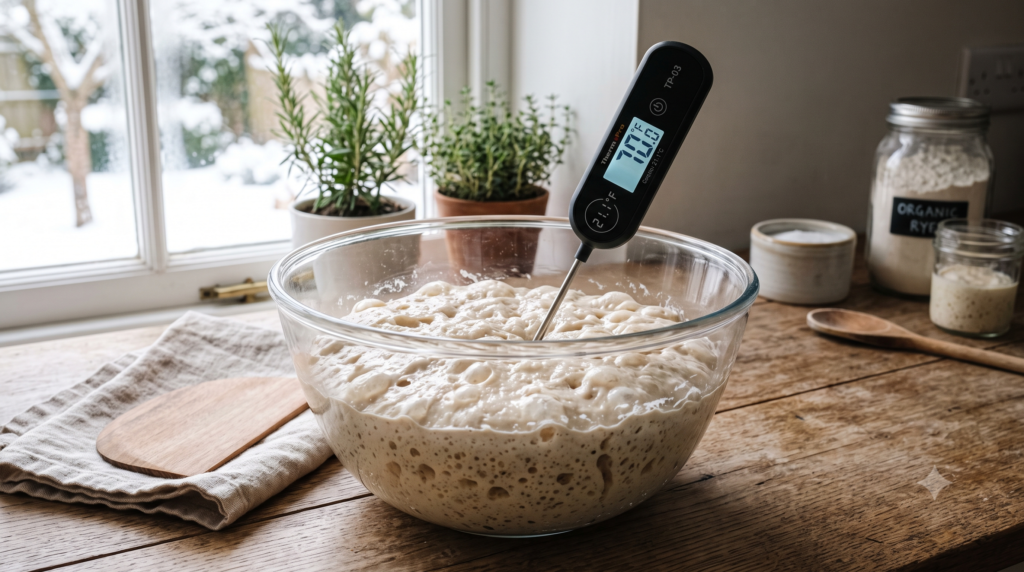
Understanding how to work with 70°F fermentation transforms what seems like a disadvantage—slow fermentation—into a strategic advantage. The extended timeline gives you breathing room in your schedule, reduces the risk of overproofing, and produces bread with complex flavor profiles that faster fermentation simply cannot achieve.
This guide breaks down everything you need to know about bulk fermenting at 70°F, including precise timing charts, visual cues, troubleshooting tips, and strategies to make cool-temperature fermentation work with your lifestyle. For comprehensive coverage of bulk fermentation at all temperatures, see our complete bulk fermentation chart.
🧮 Calculate Your Bulk Fermentation Time
At 70°F, bulk fermentation timing becomes more predictable. Use this calculator to determine your exact timeline:
Accounts for temperature, starter %, hydration, and flour type
70°F on the Bulk Fermentation Temperature Spectrum
Before we dive deep into 70°F fermentation, let’s see where this temperature fits in the broader spectrum. Understanding how 70°F compares to other common bulk fermentation temperatures helps you make informed decisions about when to use this temperature versus warmer or cooler alternatives.
Quick Temperature Comparison Chart:
| Temperature | Target Rise | Bulk Time (20% starter) | Flavor Profile | Best Use Case |
|---|---|---|---|---|
| 68°F (20°C) | 75-80% | 8-10 hours | Very tangy, assertive sour | Maximum flavor development, very cold kitchens |
| 70°F (21°C) | 50-60% | 6-8 hours | Moderately sour, complex | Overnight bulk, beginner-friendly |
| 72°F (22°C) | 45-55% | 5-7 hours | Balanced, developed | Versatile timing |
| 75°F (24°C) | 40-50% | 4-5 hours | Balanced, mild-moderate | Standard daytime baking |
| 78°F (25°C) | 30-40% | 3.5-4.5 hours | Mild, lactic | Tartine method, warm climates |
| 80°F (27°C) | 25-30% | 3-4 hours | Mild, subtle | Fast turnaround, hot kitchens |
Why This Temperature Matters: At 70°F, you’re fermenting at the cooler end of the ideal range. This creates distinct characteristics: yeast activity slows more than bacterial activity, resulting in more developed sour flavors and a more forgiving timeline. The temperature also closely matches what many unheated kitchens naturally maintain, especially in winter or temperate climates.
The longer your dough ferments at room temperature, the more time beneficial bacteria have to break down phytic acid and other compounds. Check your bulk fermentation chart for optimal fermentation times based on your kitchen temperature.Why 70°F Is Actually Ideal for Many Bakers
Most sourdough recipes assume a dough temperature of 75-78°F, which represents typical room temperature in a heated home. But many kitchens—especially in winter, in basements, or in climate-controlled environments—naturally sit at 68-72°F. Rather than fighting this temperature, smart bakers embrace it.
At 70°F, fermentation slows to a pace that accommodates real life. You can mix your dough before bed, sleep through the bulk fermentation, and wake to perfectly fermented dough ready for shaping. This “overnight bulk fermentation” method has gained massive popularity precisely because it fits modern schedules. Learn more about overnight bulk fermentation strategies to maximize this approach.
The slower fermentation at 70°F also means lactic acid bacteria have more time to work relative to yeast activity. This produces bread with more complex, nuanced sourness and better keeping qualities. Bread fermented slowly at cool temperatures often stays fresh 1-2 days longer than quickly fermented warm dough.
For beginners, 70°F provides the most forgiving learning environment. The window between “perfectly fermented” and “overproofed” stretches to 1.5-2 hours, compared to just 30-45 minutes at 80°F. This extended margin for error means you won’t ruin a batch because you checked the dough 30 minutes late. If you’re struggling with overproofed vs underproofed sourdough, cooler temperatures give you more room to learn the visual cues.
Temperature stability matters more than the exact number. A consistent 70°F throughout bulk fermentation produces more predictable results than fluctuating between 68-76°F.
Should You Bulk Ferment at 70°F? A Decision Guide
Not every bake should happen at 70°F. This temperature excels in specific situations but may not be optimal for others. Use this decision tree to determine whether 70°F bulk fermentation makes sense for your current bake.
70°F is Your Best Choice When:
✓ Your kitchen naturally runs 68-72°F – Working with your environment rather than against it produces more consistent results
✓ You want overnight bulk fermentation – The 6-8 hour timeline fits perfectly with sleeping schedules; mix at 9 PM, shape at 6 AM
✓ You prefer complex, developed sour flavors – Extended bacterial activity at cooler temps creates more nuanced acidity
✓ You’re learning bulk fermentation timing – The extended window between “ready” and “overproofed” (1.5-2 hours) forgives timing errors
✓ You’re baking in winter – Rather than heating your dough, embrace the natural cool temperature
✓ You want more scheduling flexibility – The slower pace means checking dough 30 minutes late won’t ruin your bake
Choose 75-78°F Instead When:
✗ You need same-day baking – Warmer temperatures complete bulk in 4-5 hours, allowing morning mix and evening bake
✗ You prefer mild, less sour bread – Higher temps favor yeast over bacteria, producing milder flavor profiles
✗ Your starter is sluggish – Weak starters perform better at 75-78°F where fermentation is more vigorous
✗ You’re baking enriched doughs – Butter, eggs, and milk benefit from faster fermentation to prevent off-flavors
Choose 80°F+ When:
✗ You’re in a hot climate – Fighting your environment wastes energy; work with summer temperatures
✗ You want very mild sourdough – High temps minimize sourness while maintaining rise
✗ You’re an experienced baker – Fast fermentation requires precise timing but offers quick turnaround
Can’t Decide? Default to 70°F if your kitchen is naturally cool. The forgiving nature makes it ideal for developing your fermentation intuition.
The Complete 70°F Bulk Fermentation Timing Chart
At 70°F dough temperature, expect bulk fermentation to take 6-8 hours for a typical sourdough recipe with 20% starter (based on flour weight). This is roughly double the time you’d see at warmer temperatures like 78°F, but the extended timeline creates opportunities rather than obstacles. Understanding the fermentation triangle helps you see how temperature, time, and starter percentage interact.
Detailed Timing by Starter Percentage at 70°F:
10% Starter (1:10 ratio):
- Expected time: 8-10 hours
- Best for: Overnight fermentation, maximum flavor development
- Visual cues appear: After 6-7 hours
- Ideal for: Bakers who want minimal sourness but extended timeline
15% Starter (1:6.7 ratio):
- Expected time: 7-9 hours
- Best for: Overnight schedules with morning shaping
- Visual cues appear: After 5-6 hours
- Ideal for: Balanced flavor with flexible timing
20% Starter (1:5 ratio):
- Expected time: 6-8 hours
- Best for: Standard overnight method, most predictable
- Visual cues appear: After 4-5 hours
- Ideal for: Most home bakers, beginner-friendly
25% Starter (1:4 ratio):
- Expected time: 5-7 hours
- Best for: Daytime baking, quicker turnaround
- Visual cues appear: After 3-4 hours
- Ideal for: Slightly faster results while maintaining cool fermentation benefits
30% Starter (1:3.3 ratio):
- Expected time: 4.5-6 hours
- Best for: Compressed daytime schedule
- Visual cues appear: After 3 hours
- Ideal for: When you need faster results at cool temperature
These times assume active, well-fed starter at peak ripeness (doubled in size, domed top, pleasant smell). Weak or sluggish starter can add 2-4 hours to these estimates regardless of percentage used. If your sourdough starter isn’t doubling, address that issue before attempting bulk fermentation.
The flour type also impacts timing. Whole wheat flour ferments 20-30% faster than white flour, so a 50% whole wheat dough at 70°F might complete bulk fermentation in 5-6 hours even with just 15% starter. Check our bulk fermentation chart for whole wheat for specific guidance.
For higher hydration doughs (80%+), refer to our bulk fermentation chart for high hydration dough as these ferment 15-20% faster even at cool temperatures.
70°F Bulk Fermentation Quick Reference Table
Use this table as your go-to guide. Find your starter percentage and mix time, then reference when to expect fermentation milestones. Print this page or screenshot this table for easy kitchen reference.
| Starter % | If You Mixed At | First Visual Cues | Check Point | Ready Window Opens | Latest Shape By |
|---|---|---|---|---|---|
| 10% | 9:00 PM | 3:00 AM | 5:00 AM | 7:00 AM | 9:00 AM |
| 10% | 8:00 AM | 2:00 PM | 4:00 PM | 6:00 PM | 8:00 PM |
| 15% | 9:00 PM | 2:00 AM | 4:00 AM | 6:00 AM | 8:00 AM |
| 15% | 8:00 AM | 1:00 PM | 3:00 PM | 5:00 PM | 7:00 PM |
| 20% | 9:00 PM | 1:00 AM | 3:00 AM | 5:00 AM | 7:00 AM |
| 20% | 8:00 AM | 12:00 PM | 2:00 PM | 4:00 PM | 6:00 PM |
| 25% | 9:00 PM | 12:00 AM | 2:00 AM | 4:00 AM | 6:00 AM |
| 25% | 8:00 AM | 11:00 AM | 1:00 PM | 3:00 PM | 5:00 PM |
| 30% | 9:00 PM | 11:00 PM | 1:00 AM | 3:00 AM | 5:00 AM |
| 30% | 8:00 AM | 10:00 AM | 12:00 PM | 2:00 PM | 4:00 PM |
How to Use This Table:
- First Visual Cues: When you’ll start seeing bubbles on the dough surface and sides
- Check Point: Recommended time to assess fermentation progress (expect 20-30% rise)
- Ready Window Opens: Earliest time dough should be ready to shape
- Latest Shape By: Beyond this point, watch closely for overproofing
Note: These times assume your dough maintains 70°F throughout bulk. If room temperature fluctuates or dough cools below 68°F, add 30-60 minutes to each milestone.
Volume Increase and Visual Cues at 70°F
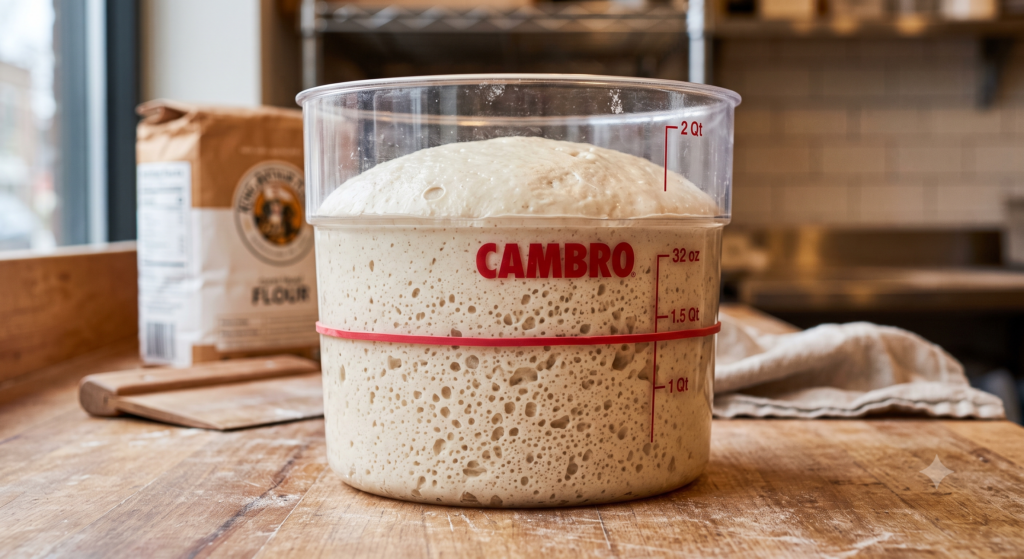
Target a 30-40% volume increase at 70°F rather than the 50-60% you’d expect at warmer temperatures. The slower fermentation produces a different visual profile that requires recalibrated expectations.
What 30-40% Rise Looks Like: Place a rubber band around your bulk fermentation container at the starting dough level. At 70°F, your dough should rise to about one-third of the way up its original height. If your dough started at 3 inches high, it should reach approximately 4 inches (33% increase). Many bakers use the aliquot method to track percentage rise more accurately.
The rise at cool temperatures appears more gradual and less dramatic than warm fermentation. You won’t see the explosive, bubbly rise that occurs at 80°F. Instead, expect a gentle, steady expansion that builds slowly over hours.
Critical Visual Indicators at 70°F:
Surface Texture: The dough top should show a slight dome—not the pronounced dome of warm fermentation, but a gentle rounding. The surface appears smooth with occasional small bubbles breaking through.
Side Bubbles: Look through your clear container sides. You should see small to medium bubbles distributed throughout the dough, concentrated especially in the upper third. At 70°F, these bubbles develop slowly but create a distinctive aerated appearance. Learn more signs your bulk fermentation is done.
Jiggle Test: Gently shake your container side to side. Properly fermented dough at 70°F jiggles as one cohesive mass with noticeable movement. It shouldn’t feel dense and heavy (underfermented) or loose and soupy (overfermented).
Dome Retention: When you perform stretch and folds during the first half of bulk fermentation, the dough should slowly build and hold a domed shape rather than spreading flat immediately after each fold.
Understanding Percentage Rise at 70°F: The Science
The 30-40% rise target at 70°F differs significantly from the 50-60% you’d see at warmer temperatures. This isn’t arbitrary—it reflects fundamental differences in how dough behaves at different temperatures.
Why Lower Percentage Rise at 70°F?
At cooler temperatures, gluten remains firmer and less extensible. This creates a dough that:
- Stands taller in the container – The structure holds better, making volume increase more visible
- Shows rise more dramatically – What looks like 40% at 70°F might visually resemble 50% at 78°F
- Maintains strength longer – Less risk of collapse during extended fermentation
- Continues fermenting slowly during shaping – The cool temp means less urgency
At warmer temperatures (78-80°F), gluten relaxes significantly due to heat. The dough:
- Spreads more in the container – Appears less risen even at higher percentages
- Looks deceptively flat – 30% at 80°F looks similar to 20% at 70°F
- Loses structure faster – Warm gluten becomes extensible and weak
- Keeps fermenting rapidly during shaping – Creating urgency to get it cold quickly
The Temperature-Rise Relationship:
| Temperature | Target Rise | Why This Target Works |
|---|---|---|
| 70°F | 30-40% | Cool gluten stays firm; dough shows rise well; slow downstream fermentation allows early cutoff |
| 75°F | 40-50% | Moderate gluten softening; balanced rise visibility; moderate downstream fermentation |
| 78-80°F | 50-60% or time-based | Warm, relaxed gluten spreads; rise less visible; rapid downstream fermentation requires fuller bulk |
This explains why the famous Tartine method (80°F bulk fermentation) can target 30% rise but appear similar to 50% rise at 70°F. The dough behaves differently at different temperatures—not just faster or slower, but fundamentally differently in terms of structure and appearance.
Practical Application: Don’t expect your 70°F dough to look like the dramatically puffy dough in photos from warm-fermentation recipes. Your dough at 40% rise and 70°F is equivalent to their dough at 60% rise and 78°F.
The Science Behind 70°F Fermentation
Understanding the microbiology at work helps you make better decisions during bulk fermentation. At 70°F, both yeast and lactic acid bacteria remain active, but their relative activity levels shift compared to warmer temperatures. This is central to understanding how dough temperature affects fermentation.
Yeast Activity at 70°F: Saccharomyces cerevisiae (bread yeast) operates efficiently across a wide temperature range, but it slows considerably below 75°F. At 70°F, yeast reproduction and CO2 production occur at roughly 60-70% the rate of 78°F fermentation. This means you need proportionally more time to achieve the same gas production and dough expansion.
Bacterial Activity at 70°F: Lactic acid bacteria—primarily Lactobacillus species—thrive in the 65-75°F range. At 70°F, these bacteria work almost as efficiently as at warmer temperatures, but they have more time relative to yeast activity. This extended bacterial action produces higher levels of lactic and acetic acids, contributing to more complex flavor.
The Flavor Impact: The ratio of bacterial acid production to yeast activity at 70°F creates bread with pronounced sourness and deeper, more developed flavors. Bakers targeting mild sourdough often prefer warmer fermentation (78-80°F) where yeast dominates. Those seeking traditional sour tang embrace cooler temperatures. If your sourdough isn’t sour enough, cooler fermentation helps.
Enzyme Activity: Amylase enzymes break down starches into simple sugars that feed both yeast and bacteria. These enzymes remain highly active at 70°F, ensuring sufficient sugar availability throughout the extended fermentation. Protease enzymes, which break down gluten, work more slowly at cool temperatures—providing better structure retention even during long bulk fermentation.
Overnight Bulk Fermentation Strategy at 70°F
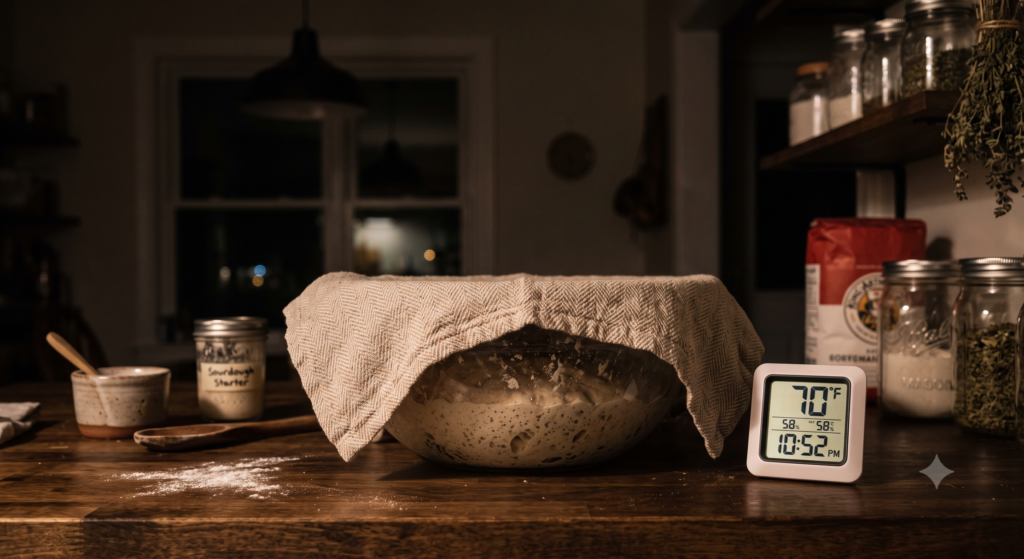
The extended timeline at 70°F works beautifully for overnight bulk fermentation, the most popular schedule among home bakers. This method lets you sleep through the longest phase of sourdough baking.
The Basic Overnight Schedule:
8:00 PM: Mix your dough using water at 80-85°F to help achieve starting dough temperature near 72-73°F. This slight warmth compensates for nighttime cooling.
8:30 PM: Perform first stretch and fold after 30-minute rest
9:00 PM: Second stretch and fold
9:30 PM: Third stretch and fold
10:00 PM: Final stretch and fold, then leave dough undisturbed
6:00-8:00 AM: Dough is ready to shape (8-10 hours total)
Temperature Management Overnight: Most homes cool down 2-4°F overnight as heating systems cycle off. If your house drops to 66-68°F overnight, this works perfectly—your dough starts at 72°F and gradually cools, extending bulk fermentation to the full 8-10 hour window. Learn more about keeping sourdough dough warm in winter conditions.
If your home stays consistently warm (74-76°F) overnight, consider reducing starter percentage to 15% or starting with cooler water (70-75°F) to slow initial fermentation.
The Kitchen Location Strategy: Place your bulk container in the coolest part of your kitchen—usually away from the stove, oven, and refrigerator heat exhaust. Counters near exterior walls tend to run cooler, especially in winter. If you’re baking sourdough in winter, location matters even more.
Signs It’s Ready in the Morning: When you wake up, your dough should show clear signs of fermentation: 30-40% volume increase, domed surface, bubbles visible through container sides, and a slightly tangy smell. If the dough looks flat with minimal rise, give it another 1-2 hours.
What If It’s Not Ready? If you wake up and your dough hasn’t risen adequately, you have options. Move it to a warmer location (75-78°F) for 1-2 hours to finish fermentation, or continue at room temperature but delay shaping until fermentation completes. A proofing box gives you on-demand warmth for these situations.
Calculating Your Desired Dough Temperature (DDT) for 70°F Bulk
To achieve consistent 70°F bulk fermentation, you need to control your starting dough temperature—what bakers call the Desired Dough Temperature (DDT). Simply mixing in a 70°F kitchen doesn’t guarantee 70°F dough temperature.
Target DDT for 70°F Bulk Fermentation: 72-73°F
Why start warmer? Your dough will gradually cool to ambient temperature during bulk fermentation. Starting at 72-73°F ensures the dough averages 70°F throughout the 6-8 hour bulk period.
Calculating Your Mixing Water Temperature
Water is your primary temperature control tool because it’s the largest ingredient by weight and easily adjustable. Use this formula to determine exactly how warm (or cool) your mixing water should be:
Formula:
(DDT × 4) - (Flour Temp + Room Temp + Starter Temp + Friction Factor) = Required Water TemperatureUnderstanding Each Variable:
- DDT (Desired Dough Temperature): 72-73°F for 70°F bulk
- Flour Temperature: Usually equals room temperature unless stored in refrigerator or cold garage
- Room Temperature: Actual kitchen temp measured with thermometer
- Starter Temperature: Temperature of your starter/levain at mixing time
- Friction Factor: Heat generated by mixing
- Hand mixing: 0°F (generates no meaningful heat)
- Stand mixer: 20-40°F (depends on speed and duration)
- Food processor: 40-60°F (generates significant heat)
Example Calculation 1: Hand Mixing in Cool Kitchen
Goal: 72°F final dough temp
Flour temp: 68°F (stored in cool pantry)
Room temp: 68°F
Starter temp: 70°F (kept on counter)
Friction factor: 0°F (hand mixing)

(72 × 4) - (68 + 68 + 70 + 0) = 288 - 206 = 82°F

Required water temperature: 82°F
Example Calculation 2: Stand Mixer in Warmer Kitchen
Goal: 72°F final dough temp
Flour temp: 72°F (room temperature)
Room temp: 72°F
Starter temp: 75°F (active starter, recently fed)
Friction factor: 25°F (stand mixer, moderate speed, 5 minutes)

(72 × 4) - (72 + 72 + 75 + 25) = 288 - 244 = 44°F

Required water temperature: 44°F (use cold water from refrigerator)
Quick Reference: Water Temperature for 70°F Bulk
If you don’t want to calculate every time, use this cheat sheet (assumes hand mixing):
| If Your Kitchen Is | Use This Water Temperature |
|---|---|
| 65°F (18°C) | 90°F (32°C) |
| 68°F (20°C) | 84°F (29°C) |
| 70°F (21°C) | 80°F (27°C) |
| 72°F (22°C) | 76°F (24°C) |
| 74°F (23°C) | 72°F (22°C) |
| 76°F (24°C) | 68°F (20°C) |
How to Heat or Cool Your Water:
- To warm: Microwave in 10-second bursts, heat on stove, or draw from hot tap
- To cool: Use water from refrigerator (typically 40°F) or add ice cubes (each cube drops ~5-10°F)
Checking Your Final Dough Temperature (FDT):
After mixing all ingredients, immediately measure your actual dough temperature with an instant-read thermometer. Insert the probe into the center of the dough mass.
- If FDT is 72-73°F: Perfect! Proceed with normal bulk fermentation
- If FDT is 75-77°F: Your bulk will finish 30-60 minutes earlier than expected; watch closely
- If FDT is 68-70°F: Your bulk will take 30-60 minutes longer; be patient
- If FDT is below 68°F: Place dough in a warmer spot (oven with light on) for first hour, then return to normal location
Pro Tip: Keep a simple log: “Kitchen 68°F, used 84°F water, FDT was 72°F, bulk finished at 7.5 hours.” After 5-10 bakes, you’ll develop intuition and won’t need the formula anymore.
Troubleshooting 70°F Bulk Fermentation
Problem: Bulk fermentation taking 10-12+ hours
This indicates weak starter, not temperature issues. At 70°F with healthy starter, bulk should never exceed 10 hours even with just 10% inoculation.
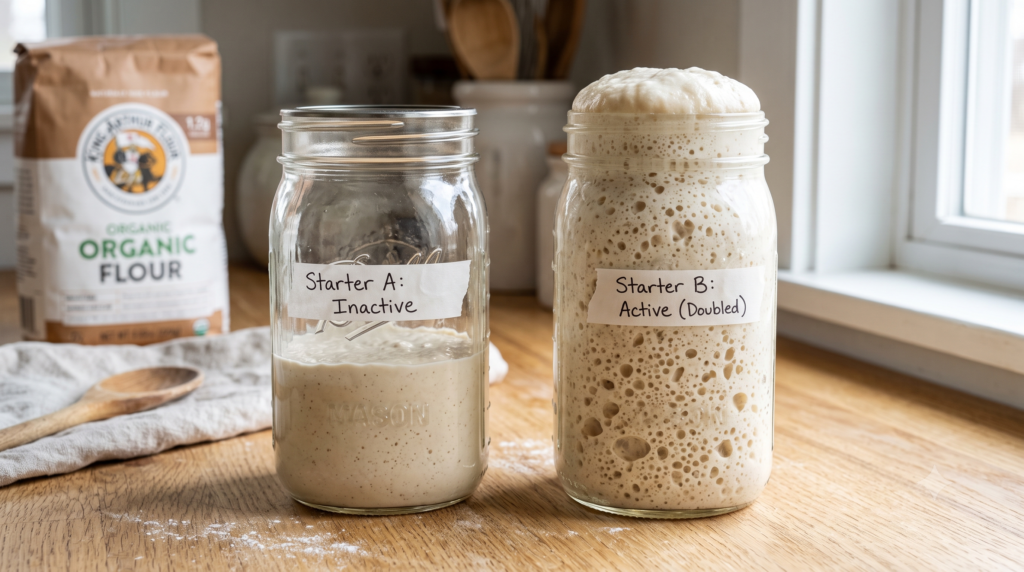
Solution: Strengthen your starter through more frequent feedings. Feed twice daily at 1:1:1 ratio for 5-7 days. Your starter should double in 4-6 hours at 70-72°F when healthy. Only once you see consistent doubling should you attempt another bulk fermentation. Read our guide on how to strengthen weak sourdough starter for detailed steps.
Problem: Dough shows no activity after 4-5 hours
Check your actual dough temperature, not just room temperature. Your thermometer might read 70°F ambient, but your dough could be 65-66°F if you used cold water or cold flour from the refrigerator.
Solution: Take dough temperature with an instant-read thermometer. If below 68°F, move to a warmer location or place in an oven with just the light on (this usually creates a 75-78°F environment). Compare proofer vs oven light methods to see which works better. Alternatively, wait longer—dough at 66°F can take 10-12 hours even with 20% starter.
Problem: Dough overproofs even at 70°F
This usually happens when actual dough temperature exceeds your target. Heat from stretch and folds, ambient temperature fluctuations, or warm water mixing can push dough temperature to 74-76°F.
Solution: Monitor dough temperature at the 4-hour mark. If it’s risen above 72°F, expect faster fermentation. Reduce starter percentage to 15% next time, or use cooler water during mixing. If you consistently struggle with bulk fermentation too long, this indicates timing miscalculation.
Problem: Inconsistent results batch to batch
Temperature fluctuations from day to day create timing variability. Monday your kitchen might be 70°F, Wednesday it’s 74°F due to weather changes or thermostat settings.
Solution: Invest in a proofing box for temperature control—check our Brod and Taylor proofer review for our top recommendation—or track your actual dough temperature each bake and adjust timing expectations accordingly. Keep a log: “20% starter, 71°F, ready at 7.5 hours” helps you build a personal reference database.
Problem: Weak gluten development despite adequate time
Insufficient stretch and folds during bulk fermentation, not temperature, causes this issue. Even at 70°F, dough needs mechanical strength development.
Solution: Perform 4-5 sets of stretch and folds during the first 3-4 hours of bulk fermentation, spaced 30-45 minutes apart. This builds gluten structure even as fermentation progresses slowly. Review our sourdough folding techniques guide for proper form.
Problem: Sour flavor too intense
The extended time at 70°F produces more acidity than some bakers prefer. Longer fermentation = more acid accumulation.
Solution: Increase starter percentage to 25-30% to shorten bulk fermentation to 5-6 hours, reducing acid accumulation. Or raise temperature to 74-76°F for a faster, milder fermentation. Compare timing with our bulk fermentation chart at 75 degrees for reference.
Adjusting Other Variables at 70°F
Water Temperature Compensation: Use warm water (80-85°F) during mixing to compensate for cool ambient temperature. This brings your starting dough temperature to 72-73°F even when working in a 70°F environment. The dough will gradually cool to ambient during bulk fermentation.
Flour Selection Impact: Bread flour with higher protein content (12-13%) provides better structure during extended cool fermentation. The stronger gluten network withstands the longer enzymatic activity period without breaking down. See our guide on best flour for sourdough beginners for recommendations.
All-purpose flour (10-11% protein) works at 70°F but may produce slightly more extensible, less structured dough. Consider increasing stretch and fold sessions to 5-6 sets to compensate.
Whole wheat flour accelerates fermentation even at 70°F due to higher enzyme content. Reduce expected timing by 20-25% when working with 50%+ whole wheat.
Hydration Adjustments: Higher hydration dough (75-80%) ferments slightly faster at any temperature. At 70°F, this might reduce your 7-hour timeline to 6-6.5 hours. Learn more about sourdough hydration percentage.
Lower hydration (65-70%) extends timing. This can be useful if you want an even longer overnight window—using 65% hydration with 15% starter at 70°F might give you a 9-10 hour bulk fermentation, perfect for a full night’s sleep.
When to Use vs. Avoid 70°F Fermentation
Best Use Cases for 70°F:
- Overnight bulk fermentation schedules
- Bakers seeking maximum flavor development
- Learning environments (extended margin for error)
- Winter baking when kitchen naturally runs cool
- Times when you need flexible timing windows
When to Choose Warmer Temperatures:
- Same-day baking schedules requiring 3-4 hour bulk
- Preference for mild, less sour bread
- Very stiff doughs (60-65% hydration) that need activity boost
- When using weak or young starter
- Hot summer days when achieving 70°F requires active cooling
Temperature Control Investment: If you frequently bake at 70°F and want consistency, a proofing box maintains exact temperature regardless of ambient conditions. Compare options in our cheap alternatives to Brod and Taylor proofer guide. Otherwise, simply work with your kitchen’s natural temperature and adjust timing accordingly.
Expert Tips for 70°F Success
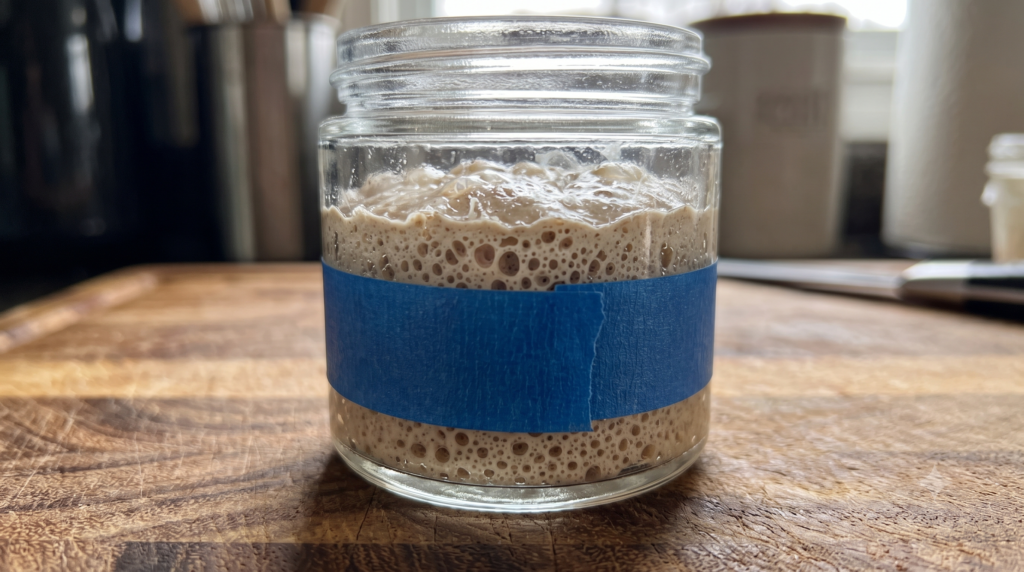
Use a Clear, Straight-Sided Container: Cylindrical or square containers with straight sides make volume increase easy to measure. Curved bowls distort visual assessment, making it harder to gauge fermentation progress. See our bulk fermentation container guide for recommendations.
Mark Starting Height: Use a rubber band, piece of tape, or dry-erase marker to mark the exact starting height. This reference point eliminates guessing about percentage rise. The aliquot jar method makes this even more precise.
Check After 5 Hours, Not Before: Resist the urge to check your dough every hour. At 70°F, significant changes won’t appear until the 4-5 hour mark. Early checking just introduces temperature fluctuations when you open the container.
The Aliquot Jar Method: Transfer a small portion (50g) of dough to a narrow, straight-sided jar immediately after mixing. This “aliquot” shows fermentation progress more clearly than the full bulk container. When it rises 40%, your bulk dough is ready regardless of what the main container looks like. Learn the full aliquot method for sourdough.
Document Your Bakes: Keep a simple log: date, starter percentage, starting dough temp, room temp, actual bulk time, and results. After 5-10 bakes, patterns emerge that help you dial in perfect timing for your specific environment.
Trust Time Over Appearance at 70°F: Cool fermentation produces less dramatic visual changes. If you’ve hit 7 hours with 20% starter and see moderate rise and bubbles, trust the timeline—your dough is likely ready even if it doesn’t look as puffy as you expected.
70°F Bulk Fermentation Troubleshooting Decision Tree
Use this flowchart to diagnose issues with 70°F bulk fermentation:
START HERE: Is your bulk fermentation taking too long (10+ hours)?
→ YES → Check your starter health
- Does starter double in 4-6 hours at room temperature?
- NO → Problem identified: Weak starter
- Solution: Feed twice daily at 1:1:1 for one week before baking
- YES → Check dough temperature
- Is dough actually at 70°F? (measure with thermometer)
- NO (below 68°F) → Problem identified: Dough too cold
- Solution: Move to warmer location or use warmer mixing water
- YES → Check starter percentage
- Using at least 20% starter?
- NO (10-15%) → Normal: Lower inoculation = longer time
- YES → Check flour type (specialty flours ferment slower)
- Using at least 20% starter?
- NO (below 68°F) → Problem identified: Dough too cold
- Is dough actually at 70°F? (measure with thermometer)
- NO → Problem identified: Weak starter
→ NO → Is bulk finishing too quickly (under 5 hours with 20% starter)?
→ YES → Check dough temperature
- Is dough actually at 70°F?
- NO (above 73°F) → Problem identified: Dough too warm
- Solution: Use cooler mixing water; place in cooler spot
- YES → Check starter percentage
- Using more than 20% starter?
- YES (25-30%) → Normal: Higher inoculation = faster time
- NO → Check if starter was past peak when added
- Using more than 20% starter?
- NO (above 73°F) → Problem identified: Dough too warm
→ NO → Is dough showing minimal rise (under 20%) after expected time?
→ YES → Check visual cues
- Do you see bubbles on surface and sides?
- YES → Normal: Rise appears less dramatic at 70°F
- Solution: Trust visual cues over volume; if bubbly and domed, it’s ready
- NO → Check if salt was forgotten or added late
- YES → Normal: Rise appears less dramatic at 70°F
Still Having Issues?
If your problem doesn’t fit this decision tree, the issue likely lies outside bulk fermentation:
- Weak oven spring: Check final proof timing and oven temperature
- Dense crumb: May be shaping technique or underproofed final rise
- Flat loaves: Could be overproofed final rise, not bulk fermentation
See our guides on overproofed vs underproofed sourdough and signs bulk fermentation is done for additional troubleshooting.
Printable Quick Reference: 70°F Bulk Fermentation Cheat Sheet
Save or print this section for easy kitchen reference
TARGET METRICS AT 70°F:
- Starting dough temp (DDT): 72-73°F
- Target rise: 30-40%
- Expected duration: 6-8 hours (20% starter)
- Stretch & folds: 4-5 sets in first 3-4 hours
TIMING BY STARTER PERCENTAGE:
- 10% starter: 8-10 hours
- 15% starter: 7-9 hours
- 20% starter: 6-8 hours (most common)
- 25% starter: 5-7 hours
- 30% starter: 4.5-6 hours
READINESS SIGNS:
- ✓ Volume increased 30-40%
- ✓ Bubbles visible through container sides
- ✓ Slight dome on surface
- ✓ Dough jiggles as one cohesive mass
- ✓ Less sticky than at mixing time
- ✓ Light, airy feel when gently shaken
WATER TEMPERATURE GUIDE:
- Kitchen 68°F → Use 84°F water
- Kitchen 70°F → Use 80°F water
- Kitchen 72°F → Use 76°F water
COMMON MISTAKES TO AVOID:
- ✗ Expecting 50%+ rise (too high for 70°F)
- ✗ Using starter past peak activity
- ✗ Skipping stretch and folds
- ✗ Checking too early (wait at least 5 hours)
- ✗ Comparing to photos from 78-80°F fermentation
WHEN TO SHAPE:
- Earliest: 30% rise + visual cues present
- Ideal: 35-40% rise + all cues present
- Latest: 45% rise or slight deflation starting
NEED MORE HELP?
- Slow fermentation → Check starter health first
- Too sour → Increase starter % or raise temp to 75°F
- Overproofing → Cut bulk earlier (30% instead of 40%)
- Inconsistent → Use proofing box for temperature control
70°F Bulk Fermentation: Frequently Asked Questions
Q: My kitchen is 68°F, not exactly 70°F. Does this 2-degree difference matter?
A: Yes, but minimally. A 2°F drop will add approximately 30-60 minutes to your total bulk fermentation time. The visual cues and percentages remain the same—just expect the longer end of the time ranges provided in this guide. If your kitchen consistently runs 68°F, simply add 45 minutes to all the timing estimates.
Q: What if my kitchen temperature fluctuates during bulk fermentation?
A: Temperature fluctuations are normal—most homes drop 2-4°F overnight and rise during the day. What matters is the average temperature during bulk. If you start at 70°F and it drops to 68°F overnight, your average is 69°F—essentially no impact. However, if temperature swings more than 5°F during bulk, fermentation becomes unpredictable. In this case, rely on visual cues rather than timing.
Q: Can I start bulk fermentation at 70°F then move the dough to the refrigerator partway through?
A: Yes, but only if you’re at least 70-80% through bulk fermentation (typically 5-6 hours in with 20% starter at 70°F). When you move dough to the refrigerator, it continues fermenting for several hours as it slowly cools to 40°F—this can take 6-8 hours. If you refrigerate too early, the dough won’t finish fermenting even with this carryover time.
Q: What water temperature should I use to achieve 70°F bulk fermentation?
A: This depends on your kitchen temperature, but typically 78-85°F water works well. In a 68°F kitchen, use 82-84°F water. In a 72°F kitchen, use 76-78°F water. The warmer mixing water brings your starting dough temperature to 72-73°F, which then cools to an average of 70°F during bulk. See the DDT calculation section above for the exact formula.
Q: Why does my dough at 70°F look less puffy and risen compared to recipes showing dramatic rise?
A: Most recipe photos and videos show dough fermented at 78-80°F, where the warm temperature makes dough spread more and appear puffier. At 70°F, your dough maintains more structure and stands taller but shows less dramatic visual rise. A 40% rise at 70°F looks similar to a 30% rise at 78°F. This is normal and correct—don’t wait for the dramatic puffiness you see in warm-fermentation photos.
Q: Should I use a proofing box for 70°F bulk fermentation, or is natural room temperature fine?
A: If your kitchen naturally maintains 68-72°F, using natural room temperature works perfectly and saves equipment costs. A proofing box becomes valuable when: (1) your ambient temperature is inconsistent (swings 5°F+ during bulk), (2) you’re baking in summer when rooms are 76°F+, or (3) you want absolute precision. For most bakers with cool kitchens, natural temperature works beautifully at 70°F.
Q: Is 70°F better than 75°F or 80°F?
A: No temperature is universally “better”—they’re different tools for different situations. 70°F excels at: overnight bulk fermentation, developing complex sour flavors, providing forgiving timing for beginners, and working with naturally cool kitchens. 75-78°F works better for: same-day baking schedules, balanced moderate sourness, and versatile all-purpose use. 80°F suits: fast turnaround times, mild bread, and hot climate baking. Choose based on your schedule, flavor preferences, and environment.
Q: My 70°F bulk fermentation took 10-12 hours instead of 6-8 hours. What went wrong?
A: The most common cause is weak or underfed starter. Test: Does your starter double in volume within 4-6 hours at room temperature after feeding? If not, your starter needs strengthening—feed twice daily at 1:1:1 ratio for a week before attempting bulk fermentation. Other causes include: actual dough temperature below 70°F (measure with thermometer), insufficient starter percentage (use 20% minimum), or very cold flour/water bringing down dough temperature.
Q: Do I need to do stretch and folds during 70°F bulk fermentation, or does the slow fermentation build structure naturally?
A: You still need stretch and folds, though 70°F fermentation is slightly more forgiving than warmer temperatures. Perform 4-5 sets of stretch and folds during the first 3-4 hours of bulk, spaced 30-45 minutes apart. These folds build gluten structure independent of fermentation—even slow-fermented dough needs mechanical strength development. Without folds, your dough will lack the structure needed for good oven spring.
Q: Can I do a shorter bulk fermentation at 70°F by increasing my starter percentage to 30-35%?
A: Yes, absolutely. Using 30% starter at 70°F reduces bulk fermentation to approximately 4.5-6 hours, making it viable for daytime baking. The tradeoff is less flavor development—the shortened fermentation time means less acid production and complexity. If you want 70°F fermentation benefits (complexity, forgiving timing) but need faster turnaround, 25-30% starter provides a middle ground at 5-7 hours.
Q: How do I keep my dough at exactly 70°F for the entire 6-8 hour bulk fermentation?
A: Several methods work: (1) Natural cool kitchen – if your kitchen maintains 68-72°F, simply leave dough on the counter away from heat sources. (2) Proofing box – set to exactly 70°F for perfect consistency. (3) Oven with light off – modern ovens often maintain 68-72°F. (4) Basement or cool room – often maintains steady cool temperatures. (5) Insulated cooler – place dough inside (no ice) to buffer temperature swings. Monitor with an ambient thermometer placed next to your dough.
Q: Does flour type affect timing at 70°F?
A: Yes, significantly. Whole wheat flour ferments 20-30% faster than white flour due to higher enzyme content. A 100% whole wheat dough might complete bulk in 5-6 hours at 70°F even with just 15% starter. Rye flour ferments even faster. Adjust timing expectations based on flour composition.
Q: What’s the difference between the percentage rise method and time-based method for 70°F bulk?
A: At 70°F, both work, but percentage rise is more reliable. Time-based method says “wait 6-8 hours with 20% starter” while percentage rise method says “wait until dough rises 30-40% regardless of time.” The percentage method accounts for variables like starter strength, exact temperature, and flour type. Use time as a guideline to know when to start checking, but rely on percentage rise and visual cues to determine readiness.
Q: Can I use 70°F bulk fermentation for enriched doughs like brioche or cinnamon rolls?
A: You can, but 75-78°F works better for enriched doughs. The butter, eggs, milk, and sugar in enriched doughs benefit from slightly faster fermentation to prevent off-flavors. At 70°F, the extended timeline gives fats more time to oxidize. If you must use 70°F (due to kitchen temperature), increase starter to 25-30% to shorten bulk fermentation to 5-6 hours.
Final Thoughts
Mastering bulk fermentation at 70°F unlocks scheduling flexibility and flavor depth that warmer fermentation cannot match. The extended timeline accommodates real-life schedules, provides generous margin for error, and produces bread with complex, developed character.
Success at 70°F comes from understanding that slower doesn’t mean inferior—it means different visual cues, adjusted expectations, and patience rewarded with exceptional bread. Track your dough temperature, use appropriate starter percentages, and trust the process. Within 5-10 bakes, cool fermentation will feel natural and your timing instincts will become reliable.
For complete temperature-specific guidance, explore our bulk fermentation chart hub and temperature-specific guides at 75 degrees and 80 degrees.