
How to Use Sourdough Starter
- Active Starter vs. Discard: Know the Difference
- How to Know When Your Starter Is Ready
- How Much Sourdough Starter to Use
- Using Active Starter to Make Bread
- Can You Use Starter Straight from the Fridge?
- 10 Ways to Use Sourdough Starter and Discard
- Building a Levain vs. Using Starter Directly
- Common Mistakes When Using Sourdough Starter
- Sample Baking Timeline
- Frequently Asked Questions
You’ve built a sourdough starter. It’s bubbling. It’s rising. Now the question every beginner asks: how do I actually use it?
Don’t have a starter yet? Here’s our easy sourdough starter recipe to get you going from scratch. If your starter isn’t reliably doubling yet, start with our complete guide to feeding and maintaining sourdough starter first — a strong starter is the foundation of everything below.
This guide covers everything: when your starter is ready, how much to use, what you can make with it, and how to use the discard you’d otherwise throw away.
Active Starter vs. Discard: Know the Difference
Before you use your starter in anything, you need to understand the two forms it takes — because they are used in completely different ways.
Active starter is starter that has been fed within the last 4–8 hours and is at or near its peak. It has doubled in size, the surface is domed and full of bubbles, and it smells pleasantly yeasty. This is what you use to leaven bread — it contains enough active yeast to make dough rise without commercial yeast. Not sure if yours qualifies? Here’s how to know when your sourdough starter is ready to use.
If your starter just won’t grow after feeding, our guide on a sourdough starter that won’t double will help you troubleshoot. You can also check our sourdough starter not working guide for a full diagnosis.
Discard is the portion you remove from your jar before each feeding. It’s unfed, past its peak, and doesn’t have enough rising power to leaven bread on its own. But it’s packed with flavour and is perfect for pancakes, crackers, flatbread, muffins, pizza dough, and dozens of other recipes. For details on how long you can keep it, see our guide on how long sourdough discard lasts. You can also freeze your discard and accumulate it for larger bakes later.
The key rule: active starter for bread. Discard for everything else.
How to Know When Your Starter Is Ready to Use
Timing matters. Using your starter too early (still rising) or too late (already collapsed) will give you weaker results. Here are the four signs that your starter is at peak and ready to go:
- Doubled in size from your rubber band mark (or more).
- Domed surface — slightly rounded on top, not flat or sunken.
- Full of bubbles — visible through the glass and breaking on the surface.
- Pleasant smell — mildly tangy and yeasty, like beer. Not sharp or like acetone. If it smells like acetone, see our guide on fixing a starter that smells like acetone.
The Float Test
If you’re unsure, use the float test. Drop a small spoonful of starter into a glass of room-temperature water. If it floats, the yeast is producing enough carbon dioxide and your starter is ready. If it sinks, give it more time or another feeding. For a complete visual walkthrough of each peak stage, see our sourdough starter feeding guide.
You can also use our sourdough starter feeding ratio chart to understand exactly when peak activity occurs at different temperatures.
How Much Sourdough Starter to Use
The amount of starter you add to a recipe directly affects how fast the dough ferments and how sour the final product tastes.
- More starter (150g+) = faster fermentation, milder flavor, shorter rise time.
- Less starter (50–75g) = slower fermentation, more developed sour flavor, longer rise.
- Standard amount = most bread recipes call for 75–150g of active starter. A good starting point is 100g.
If you’re new to sourdough baking, stick to the amount your recipe specifies. As you gain experience, you can adjust up or down to fit your schedule and flavor preferences. Understanding how dough temperature affects fermentation will help you fine-tune this. Our bulk fermentation chart shows exactly how starter quantity changes your fermentation timeline at different temperatures.
Using Active Starter to Make Bread
This is the main event — the reason most people create a starter in the first place. Here’s the basic workflow for using your active starter in a loaf of sourdough bread:
- Feed your starter. Use a 1:1:1 ratio and wait for it to double (usually 4–6 hours at 75–80°F). Our sourdough starter feeding ratio chart is a lifesaver when you’re just starting out.
- Measure out what your recipe needs. Most recipes call for 75–150g of active starter. Scoop it out at peak.
- Feed the remaining starter in your jar so it stays healthy for next time. Or refrigerate it if you won’t bake again soon.
- Mix the dough. Combine your starter with flour, water, and salt according to your recipe. For a full walkthrough, see our step-by-step sourdough bread guide and our guide on how to mix sourdough dough.
- Bulk fermentation. Let the dough rise at room temperature until it has grown 50–75% in volume. This is where the starter does its work — producing gas and developing flavor. Our bulk fermentation guide explains the timing and visual cues, and our bulk fermentation chart maps exact times to temperatures.
- Shape, proof, and bake. Shape your dough into a boule or batard, cold proof overnight in the fridge (12–48 hours), and bake in a Dutch oven or without one.
The entire process from feeding your starter to pulling bread from the oven typically takes 24–36 hours, with most of that being hands-off waiting time. For a complete beginner walkthrough, see our beginner sourdough recipe.
Can You Use Sourdough Starter Straight from the Fridge?
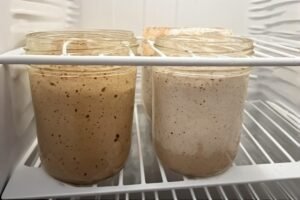
For bread: no. A cold, unfed starter won’t have enough yeast activity to give your dough a proper rise. You’ll end up with dense, under-fermented bread with poor oven spring. Always give refrigerated starter at least one feeding at room temperature (ideally two, spaced 8–12 hours apart) before using it in bread.
For discard recipes: yes. Pancakes, crackers, muffins, flatbread, and pizza dough don’t rely on the starter for leavening — they use baking powder, baking soda, or just don’t need to rise. Cold discard straight from the fridge works perfectly in these recipes.
If your starter has been in the fridge for more than two weeks, it may need extra feedings to restore full activity. See our guide on why your starter isn’t working if it seems sluggish after refrigeration, or our guide to reviving a dried sourdough starter if it has been stored long-term.
10 Ways to Use Sourdough Starter and Discard
Your starter is more versatile than you think. Here’s what you can make with both active starter and discard. If you have leftover discard after feeding, don’t throw it out — the recipes below use every drop.
With Active Starter (Fed & At Peak)
- Sourdough bread — The classic. Follow our beginner sourdough recipe for your first loaf, or our complete guide to making sourdough from starter.
- Focaccia — One of the most forgiving sourdough breads. Great for beginners and perfect for rescuing over-proofed dough.
- Pizza dough — See our guide to the best flour for sourdough pizza and our same-day pizza recipe.
- Sandwich bread — Softer crumb, perfect for everyday slicing.
- Rolls & buns — Dinner rolls, burger buns, cinnamon rolls.
With Discard (Unfed, Any Temperature)
- Pancakes — Fluffy sourdough discard pancakes are a weekend staple.
- Crackers — Our rosemary sea salt crackers are addictive and take 30 minutes.
- Muffins — Try our baker-style discard muffins.
- Tortillas — Sourdough discard tortillas are soft, pliable, and better than store-bought.
- Flatbread — No-yeast flatbread ready in under 20 minutes.
Building a Levain vs. Using Starter Directly
Some recipes call for a “levain” (also spelled “leaven”) instead of using starter directly. A levain is simply a small offshoot of your starter that you build specifically for one bake.
Why build a levain? It lets you customize the flour blend, hydration, and fermentation time for a specific recipe without changing your main starter. For example, you might maintain your starter with bread flour but build a levain with 20% whole wheat for a particular loaf. Understanding sourdough hydration helps here as levains are often built at different hydration levels than your main starter.
How to build one: Take a small amount of active starter (10–25g) and feed it with the flour and water specified in your recipe. Let it rise to peak (usually 4–8 hours), then use the entire amount in your dough. Your main starter stays untouched in its jar.
If you’re a beginner, don’t worry about levains yet. Using your starter directly works perfectly well. This is an intermediate technique you can explore once you’re comfortable with basic baking.
Common Mistakes When Using Sourdough Starter
Using it before peak
If your starter has only risen 50% and you mix it into dough, you won’t get a full rise. Be patient and wait for it to double. Track it with a rubber band so you know exactly where it started. See our starter chart for peak timing at different temperatures.
Using it after it’s collapsed
Once your starter has peaked and fallen back down significantly, the yeast has exhausted its food. Using collapsed starter leads to dense, under-risen bread. If you missed the peak, feed it again and wait for the next cycle. This is one of the most common reasons for dense sourdough.
Not feeding before baking
Pulling starter straight from the fridge and mixing it into bread dough is the most common beginner mistake. Always feed it first and wait for it to double. The only exception is discard recipes that don’t rely on the starter for leavening.
Using too much or too little
Stick to what your recipe specifies until you understand how starter quantity affects fermentation timing. Too much starter and your dough over-ferments quickly. Too little and it barely rises. Learn the visual cues in our guide to knowing when sourdough is ready and how to know when bulk fermentation is done.
Forgetting to save some for next time
Before you scoop starter into your dough, always make sure you’ve left enough in the jar (at least 25–50g) to feed and maintain for your next bake.
Sample Baking Timeline
Here’s a realistic weekend baking schedule showing exactly when and how to use your starter:
- Friday 8:00 PM — Take starter out of fridge. Discard to 50g. Feed 1:1:1 (50g flour + 50g water). Leave at room temp.
- Saturday 8:00 AM — Starter should be near peak. Feed again: discard to 50g, add 100g flour + 100g water (building enough for your recipe).
- Saturday 2:00 PM — Starter is doubled and domed. Scoop out what your recipe needs. Feed remaining starter and return to fridge.
- Saturday 2:30 PM — Mix dough. Begin bulk fermentation with stretch and folds.
- Saturday 8:00 PM — Shape dough. Place in banneton. Cold proof in fridge overnight.
- Sunday 8:00 AM — Preheat oven with Dutch oven inside (500°F). Score the dough. Bake.
- Sunday 9:00 AM — Bread is done. Let cool for at least 1 hour before slicing. Learn how long sourdough bread lasts and how to store it properly.
Frequently Asked Questions
How do you use sourdough starter?
Feed your starter with equal parts flour and water and wait 4–8 hours until it doubles in size and the surface domes. At peak activity, scoop out the amount your recipe calls for (usually 75–150g) and mix it into your dough with flour, water, and salt. Then bulk ferment at room temperature for 4–8 hours, shape, cold proof overnight, and bake. Use unfed discard for recipes like pancakes, crackers, and flatbread that don’t rely on the starter for leavening.
Can I use sourdough starter instead of yeast?
Yes — that’s the whole point of sourdough. Your active starter replaces commercial yeast entirely. The trade-off is that sourdough fermentation takes longer (hours instead of minutes), but you get better flavor, texture, and digestibility. For more on this, read our guide on sourdough without commercial yeast and whether sourdough is truly yeast-free.
How long after feeding can I use my starter?
Use it when it has doubled in size and is at peak activity. At 75–80°F with a 1:1:1 feed, this typically takes 4–6 hours. In cooler kitchens (65–70°F), it may take 8–12 hours. Check our proofing time chart and starter chart for temperature-specific timing.
What if I missed the peak?
If your starter has fully collapsed, feed it again and catch the next peak. Don’t try to use collapsed starter for bread — the yeast has already burned through its food and won’t give you a strong rise. This is one of the main causes of flat sourdough loaves.
Can I use discard in bread?
Discard alone won’t leaven bread. But some recipes combine discard with a small amount of commercial yeast for flavor without the full sourdough timeline. If you want pure sourdough bread, always use active, peaked starter. For discard-specific ideas, see our full list of sourdough discard recipes.
Does it matter what flour I feed my starter before baking?
The flour you feed affects flavor and fermentation speed. Bread flour gives reliable, moderate activity. Adding 10–20% whole rye speeds things up significantly. Stick to whatever your starter is accustomed to for consistent results. Our sourdough hydration guide explains how different flours absorb water differently and affect your starter’s consistency.
How do I know if my sourdough starter is strong enough to bake with?
Your starter is ready to bake with when it consistently doubles within 4–8 hours of feeding, has a domed surface at peak, smells pleasantly sour and yeasty, and passes the float test. If it meets all four criteria reliably for two or three consecutive feedings, it is strong enough to leaven bread. If not, consult our sourdough starter beginner guide to get it back on track.
What to Do Next
Now that you know how to use your sourdough starter, the next step is putting it to work:
- Bake your first loaf — Follow our complete sourdough bread guide for a beginner-friendly recipe with full instructions.
- Master the feeding routine — If your starter isn’t consistently doubling, our feeding and maintenance guide will get it there.
- Learn to troubleshoot — Bread coming out dense? Flat? Gummy? Check our guides on dense sourdough, flat sourdough, or gummy crumb.
- Understand fermentation — Our bulk fermentation chart and cold proofing guide will help you nail the timing every time.