👈 Back to Master Bulk Fermentation Chart — Compare all temperatures (65–85°F)
Jump to another guide: 70°F • 75°F • 80°F • Whole Wheat • Beginners
High hydration sourdough dough—anything above 78% water-to-flour ratio—ferments faster, feels slacker, and shows different visual cues than standard 70-75% hydration dough. If you’ve been following bulk fermentation charts designed for moderate hydration and recently pushed your water percentage higher, you’ve probably noticed your dough finishing earlier than expected or struggling to hold its shape during shaping.
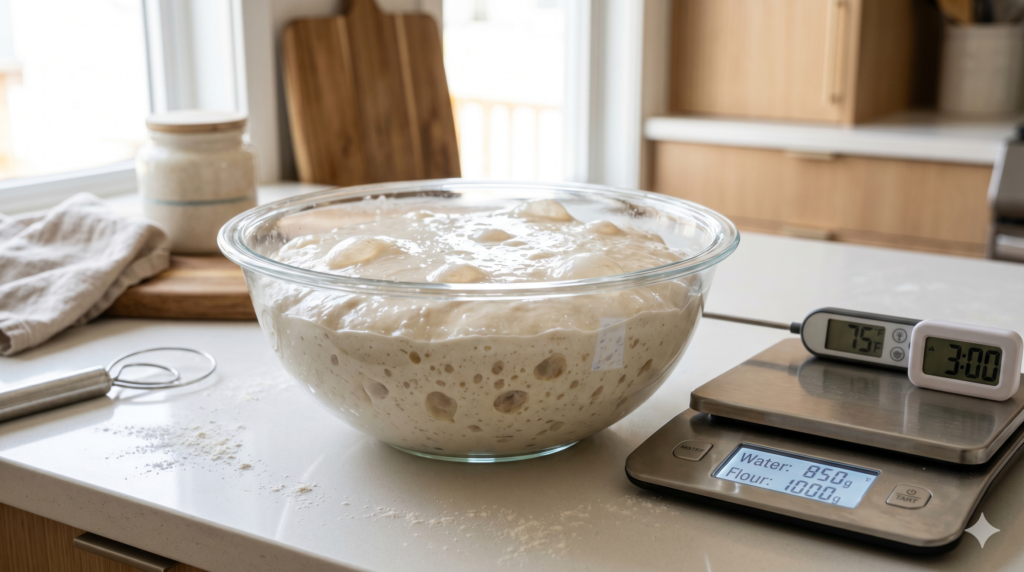
This chart accounts for the accelerated fermentation and structural challenges that come with 78-85%+ hydration. You’ll get shorter bulk fermentation windows, modified folding schedules, and visual cues that work when your dough is too wet to rely on standard rise measurements.
Why High Hydration Dough Ferments Faster
Water is the medium that allows yeast and bacteria to move through dough. The more water you add, the easier it is for microorganisms to access flour particles and convert starches into sugars. At 85% hydration, your starter’s yeast and bacteria travel more freely than at 70% hydration, which speeds up fermentation by 20-40% depending on temperature and starter strength.
Higher hydration also means enzymes (amylase and protease) work more efficiently. These enzymes break down starches and proteins faster in a wetter environment, producing more available sugars for fermentation and weakening gluten structure more quickly. This is why high hydration dough can overproof before it visually doubles, while a lower hydration dough might still look under-risen at the same fermentation stage.
🧮 Calculate Your Bulk Fermentation Time
High hydration dough requires timing adjustments. Calculate your exact bulk fermentation time:
Accounts for temperature, starter %, hydration, and flour type
At 75°F, a 70% hydration dough might take 4-6 hours to finish bulk fermentation. The same recipe at 85% hydration will finish in 3-4 hours. If you’re following a standard bulk fermentation chart without adjusting for hydration, you’ll overshoot by 1-2 hours.
High Hydration Bulk Fermentation Chart by Temperature
This chart covers 78-85%+ hydration at common room temperatures. Times assume 20% ripe starter (100% hydration), bread flour or a blend with at least 12% protein, and 2% salt. Adjust if your starter percentage differs or you’re using lower-protein flour.
70°F (21°C) – Overnight High Hydration Fermentation
- 78% hydration: 4.5-5.5 hours (40-50% rise)
- 82% hydration: 4-5 hours (35-45% rise)
- 85% hydration: 3.5-4.5 hours (30-40% rise)
At 70°F, high hydration dough still ferments noticeably faster than standard hydration. An 85% hydration dough will be ready in under 5 hours, compared to 6-8 hours for a 70% hydration dough at the same temperature. If you’re used to overnight bulk fermentation at this temperature, cut your timeline by 25-30% for high hydration dough.
75°F (24°C) – Standard High Hydration Fermentation
- 78% hydration: 3.5-4.5 hours (40-50% rise)
- 82% hydration: 3-4 hours (35-45% rise)
- 85% hydration: 2.5-3.5 hours (30-40% rise)
This is the most common working temperature for high hydration dough. An 85% hydration dough will finish in 2.5-3.5 hours—watch it closely after 2 hours. A 78% hydration dough gives you slightly more margin, finishing around 3.5-4.5 hours. Compare this to the 75°F bulk fermentation chart for standard hydration timing.
80°F (27°C) – Fast High Hydration Fermentation
- 78% hydration: 3-3.5 hours (35-45% rise)
- 82% hydration: 2.5-3 hours (30-40% rise)
- 85% hydration: 2-2.5 hours (25-35% rise)
At 80°F, high hydration fermentation accelerates dramatically. An 85% hydration dough can finish in 2 hours. You’ll need to check it every 20-30 minutes after the first hour. The dough will feel noticeably looser and more extensible than at cooler temperatures. See the 80°F bulk fermentation chart for standard hydration comparison.
Visual Cues for High Hydration Dough
High hydration dough behaves differently than standard hydration dough. The extra water makes it harder to judge fermentation by volume alone because the dough spreads more than it rises. You need to rely on a combination of visual cues rather than a single measurement.
Dough Volume
Expect a 30-50% rise depending on your exact hydration level. A 78% hydration dough will rise 40-50%. An 85% hydration dough will rise 30-40%. Mark your container at the start, but don’t rely solely on this measurement—high hydration dough spreads outward as it rises, so the height increase is less dramatic than with lower hydration dough.
Dough Surface
Look for a domed, bubbly surface with visible gas pockets just under the skin. High hydration dough shows larger, more irregular bubbles than standard hydration dough. The surface should look slightly glossy and stretched, not flat or wet. If you see large bubbles breaking through the surface, you’re approaching overproofing.
Jiggle Test
Gently shake your container. High hydration dough should wobble like loose jello or panna cotta, not jiggle like firm jello. It will move more than standard hydration dough at the same fermentation stage. If it barely moves, it needs more time. If it sloshes like batter or the surface looks broken, it’s overproofed.
Finger Poke Test
Wet your finger and gently press the dough surface. It should slowly spring back about halfway, leaving a slight indentation. High hydration dough springs back more slowly than lower hydration dough because the gluten network is more relaxed. If it springs back immediately, it needs more time. If it doesn’t spring back at all, it’s overproofed. Learn more about the poke test.
Smell
Properly fermented high hydration dough smells mildly tangy and yeasty with a slight sweetness. If it smells strongly sour or alcoholic, it’s overproofed. High hydration dough can develop acetic acid faster than standard hydration because the increased water activity accelerates bacterial fermentation alongside yeast activity.
Folding Schedule for High Hydration Dough
High hydration dough needs more frequent stretch-and-folds than standard hydration dough to build and maintain structure. The extra water weakens the gluten network, so you need to reinforce it mechanically through folding.
For 78-82% hydration, use 4-5 sets of folds spaced 30 minutes apart during the first 2-2.5 hours of bulk fermentation. For 85%+ hydration, use 5-6 sets of folds spaced 20-30 minutes apart during the first 2-3 hours. After the final fold, let the dough rest undisturbed for the remaining bulk fermentation time.
Each fold should be gentle—grab one edge of the dough, stretch it up, and fold it over the center. Rotate the container 90 degrees and repeat until you’ve folded all four sides. High hydration dough tears more easily than standard hydration, so use wet hands and avoid aggressive pulling. See folding techniques for more detail.
If your dough feels too slack or spreads excessively between folds, increase your folding frequency. If it feels tight or tears during folding, reduce your folding frequency or use a gentler technique like coil folds instead of stretch-and-folds.
Temperature Control for High Hydration Dough
Temperature control is critical for high hydration dough because the faster fermentation rate means temperature swings have a bigger impact. A 5°F difference can shorten or extend your bulk fermentation window by 45-60 minutes at high hydration, compared to 30-45 minutes at standard hydration.
If your kitchen runs warm (78°F+), consider starting with your ingredients cold from the refrigerator to lower your initial dough temperature. High hydration dough generates more heat during fermentation because the increased microbial activity produces more metabolic heat. Your dough temperature can climb 3-5°F above room temperature during bulk fermentation.
At 68°F, an 85% hydration dough will take 4-5 hours instead of 2.5-3.5 hours at 75°F. At 82°F, it will finish in 2-2.5 hours. If you need to slow down fermentation for scheduling purposes, lower your dough temperature or reduce your starter percentage. Learn more about dough temperature and DDT.
Use a proofing box if your kitchen temperature fluctuates more than 3-4°F during bulk fermentation. High hydration dough is less forgiving of temperature swings because the faster fermentation rate means small changes compound quickly.
Common High Hydration Bulk Fermentation Mistakes
Using Standard Hydration Timing
An 85% hydration dough at 75°F will finish in 2.5-3.5 hours, not 4-6 hours. If you follow a standard hydration timeline, you’ll add 1-2 extra hours of fermentation, which breaks down the gluten structure and produces a dough that spreads uncontrollably during shaping. Cut your expected bulk fermentation time by 20-30% when increasing hydration above 78%.
Insufficient Folding
High hydration dough needs 4-6 sets of folds to build adequate structure. If you’re only doing 2-3 sets (adequate for 70% hydration), your dough will be too weak to shape properly. The dough will spread instead of holding tension, and you’ll end up with a flat loaf even if fermentation timing was correct.
Waiting for Doubling
High hydration dough rarely doubles during bulk fermentation. It spreads more than it rises, so you might only see a 30-40% volume increase even when fermentation is complete. If you’re waiting for doubling, you’ll overproof every time. Trust the combination of visual cues—domed surface, large bubbles, jiggle test, poke test—rather than volume alone.
Overproofing in Warm Kitchens
If your kitchen runs 78-80°F, your 85% hydration dough can finish bulk fermentation in 2-2.5 hours. Many bakers don’t check their dough until 3-4 hours, by which point it’s overproofed. Set a timer to check your dough 30 minutes before you think it will be ready, especially in warm kitchens.
Adjusting Starter Percentage for High Hydration
Because high hydration dough ferments faster, you can reduce your starter percentage to extend your bulk fermentation window and improve manageability. Standard recipes use 15-20% starter. For high hydration dough, consider dropping to 10-15% starter if you want a longer timeline.
At 75°F with 10% starter, an 85% hydration dough will take 3.5-4.5 hours instead of 2.5-3.5 hours with 20% starter. This gives you more flexibility for folding, better structure development, and a wider window to catch the dough at peak fermentation.
If you’re using 25-30% starter (common in some recipes), expect your high hydration dough to finish 30-40% faster than the times listed in this chart. An 85% hydration dough at 75°F with 30% starter can finish in 2-2.5 hours. Use the bulk fermentation time calculator to adjust for your specific starter percentage.
Flour Selection for High Hydration Dough
High hydration dough requires strong flour to maintain structure. Use bread flour with at least 12% protein, or a blend of bread flour and high-protein whole wheat flour. All-purpose flour (10-11% protein) struggles to hold high hydration dough together, resulting in excessive spreading and poor structure.
Some bakers add 5-10% high-protein flour like Tipo 00 or vital wheat gluten to boost protein content and improve structure. This doesn’t significantly change fermentation timing but makes the dough easier to handle during shaping. See best flour for sourdough for more guidance.
Whole wheat flour at high hydration (80%+) ferments even faster than white flour at the same hydration. A 50% whole wheat blend at 85% hydration will finish bulk fermentation 20-30% faster than 100% white flour at 85% hydration. Check the whole wheat bulk fermentation chart for specific timing.
Troubleshooting High Hydration Bulk Fermentation
Dough Spreads During Shaping
This happens when either bulk fermentation went too long or you didn’t do enough folds. High hydration dough has a narrow window—once it’s ready, you have 15-20 minutes before it tips into overproofing. If your dough spreads uncontrollably, check your fermentation timing and increase your folding frequency in the next bake. See how to save overproofed sourdough.
Dough Tears During Folding
Either your gluten hasn’t developed enough yet or you’re folding too aggressively. High hydration dough needs a longer autolyse (45-60 minutes) to develop initial gluten structure before you add starter and salt. If you’re skipping the autolyse or cutting it short, the dough will tear during the first few folds. Use wet hands and gentler stretches.
Dough Feels Too Wet
If your dough feels unmanageably wet even after 4-5 folds, you’ve likely exceeded the absorption capacity of your flour. Drop your hydration by 2-3% in the next bake. Not all bread flours can handle 85% hydration—some max out at 80-82% depending on protein content and quality. See sourdough hydration explained.
No Rise After 6 Hours
If your high hydration dough shows minimal rise after 6 hours, your starter is weak or your temperature is too low. High hydration doesn’t compensate for a sluggish starter. Test your starter by dropping a spoonful in water; it should float. If it doesn’t, you need to strengthen your starter before attempting high hydration dough.
Hydration Levels and Fermentation Speed
Here’s how different hydration levels affect bulk fermentation timing at 75°F with 20% starter:
- 70% hydration: 4-6 hours (40-50% rise)
- 75% hydration: 3.5-5 hours (40-50% rise)
- 78% hydration: 3.5-4.5 hours (40-50% rise)
- 82% hydration: 3-4 hours (35-45% rise)
- 85% hydration: 2.5-3.5 hours (30-40% rise)
- 88% hydration: 2-3 hours (25-35% rise)
Each 5% increase in hydration speeds up fermentation by roughly 15-20%. This compounds—an 88% hydration dough ferments nearly twice as fast as a 70% hydration dough at the same temperature. Small hydration changes have big timing impacts at the high end of the range.
When to Use High Hydration
High hydration dough produces a more open crumb with larger, irregular holes. It’s ideal for rustic breads, ciabatta-style loaves, and baguettes where you want a light, airy texture. It’s not ideal for sandwich loaves or tight-crumb breads where you want even, small holes.
High hydration requires more attention during bulk fermentation and shaping. If you’re a beginner, start at 70-75% hydration and work your way up gradually. Each 3-5% increase in hydration requires adjustments to timing, folding frequency, and handling technique. Don’t jump from 70% to 85% in one bake—the learning curve is steep.
For a simplified approach to bulk fermentation without worrying about hydration calculations, see the bulk fermentation chart for beginners.
Cold Fermentation for High Hydration Dough
Many bakers use cold bulk fermentation for high hydration dough to slow down the process and make it more manageable. Mix your dough in the evening, do 2-3 folds over the first hour, then refrigerate for 12-18 hours at 38-40°F. Shape the next morning when the dough is cold and easier to handle.
Cold fermentation extends your window dramatically. An 85% hydration dough that would finish in 2.5-3.5 hours at 75°F can ferment for 14-16 hours in the refrigerator without overproofing. The cold temperature slows yeast and bacteria activity by 80-90%, giving you much more control over timing.
When using cold bulk fermentation, expect less rise than room temperature fermentation—typically 20-30% instead of 30-40%. The dough will feel firmer and easier to shape when cold, but it needs to come to room temperature during final proofing to achieve good oven spring. Learn more about bulk fermentation in the fridge.
Quick Reference: High Hydration Bulk Fermentation by Temperature
Here’s a condensed reference for 85% hydration dough with 20% starter at different temperatures:
- 68°F: 4-5 hours (30-40% rise)
- 70°F: 3.5-4.5 hours (30-40% rise)
- 72°F: 3-4 hours (30-40% rise)
- 75°F: 2.5-3.5 hours (30-40% rise)
- 78°F: 2.5-3 hours (25-35% rise)
- 80°F: 2-2.5 hours (25-35% rise)
For 78% hydration, add 30-45 minutes to these times. For 82% hydration, add 15-30 minutes. For 88%+ hydration, subtract 15-30 minutes. These are starting points—your flour protein content and folding technique will shift the timeline slightly.
If you need a printable version of this chart to keep in your kitchen, check out the printable bulk fermentation chart for a quick reference guide.
For more bulk fermentation resources, see: